呈 (chéng) means "to present; to submit; to show" in Chinese. It has 7 strokes with the radical 口, and is HSK Level 7.
Rated 3.5/5 in difficulty (challenging).
Harder than 15% of HSK Level 7 characters.
Appears in 3+ common words including 呈现 (chéng xiàn), 呈报 (chéng bào), 呈请 (chéng qǐng).
Due to its 7 strokes, Hanzi Writer's error detection shows 呈 requires focused practice — most learners need 10+ attempts for consistent accuracy.
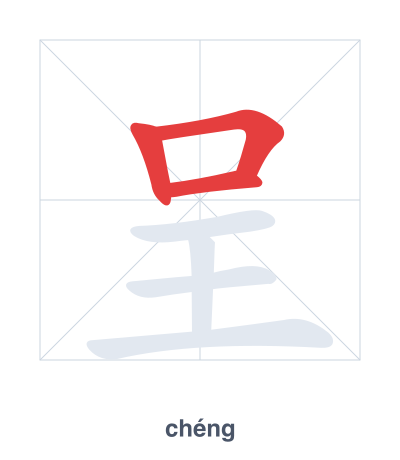
Open Hanzi Writer to see the animated stroke order and practice writing 呈 with real-time feedback.
The character 呈 (chéng) is written with 7 strokes. Follow the standard Chinese stroke order: top to bottom, left to right, outside before inside. The radical 口 is one of its key components.
Practice the correct stroke order with the Hanzi Writer app to see animated stroke-by-stroke guidance with real-time feedback.
呈 means to present; to submit; to show.
As an HSK Level 7 character, 呈 is an intermediate-level character.
呈 combines 口 (mouth) and 王 (king). The mouth represents speaking or presenting, while the king is the authority to whom something is submitted. Together, they depict a person presenting a report or gift to a ruler.
💡 Memory Tip: Picture a king (王) opening his mouth (口) wide to say 'Submit your report to me!'
湖面呈现出蓝色。
hú miàn chéng xiàn chū lán sè
The lake surface appears blue.
结果已经向上呈报。
jié guǒ yǐ jīng xiàng shàng chéng bào
The results have been reported to the higher-ups.
呈请老师批改作业。
chéng qǐng lǎo shī pī gǎi zuò yè
Submit the homework to the teacher for grading.
Open Hanzi Writer to see the animated stroke order and practice writing 呈 with real-time feedback.
✨ Animated stroke order · Handwriting recognition · HSK-graded practice · Free to use
The character 呈 is made of two parts: the top part is 口 (mouth) and the bottom part is 王 (king). This structure suggests using your mouth to speak to a king, which connects to the meaning of presenting or reporting to a superior. The combination visually represents the act of submitting something upward in a hierarchy.