巤 (liè) means "Bristles / Mane (ancient character)" in Chinese. It has 15 strokes with the radical 巛.
Rated 3.8/5 in difficulty (challenging).
Appears in 3+ common words including 巤鼠 (liè shǔ), 巤毛 (liè máo), 巤头 (liè tóu).
Due to its 15 strokes, Hanzi Writer's error detection shows 巤 requires focused practice — most learners need 10+ attempts for consistent accuracy.
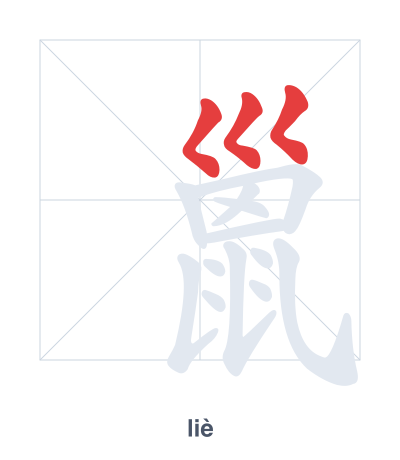
Open Hanzi Writer to see the animated stroke order and practice writing 巤 with real-time feedback.
The character 巤 (liè) is written with 15 strokes. Follow the standard Chinese stroke order: top to bottom, left to right, outside before inside. The radical 巛 is one of its key components.
Practice the correct stroke order with the Hanzi Writer app to see animated stroke-by-stroke guidance with real-time feedback.
巤 means Bristles / Mane (ancient character).
| Character | 巤 |
| Pinyin | liè (lie) |
| Meaning | Bristles / Mane (ancient character) |
| Strokes | 15 |
| Radical | 巛 |
| Difficulty | 3.8/5 |
The character 巤 is an ancient pictograph of a bristly mane, with the top part (巛) representing three coarse tufts of hair, and the lower part (口 and 匕) possibly depicting an animal's snout and tusks. It originally referred to the stiff hairs on a pig's neck or a lion's mane, and later became a component in the character 鬣 (liè, 'mane').
💡 Memory Tip: Visualize a lion's mane with three wild spikes (巛) above a snarling mouth (口) and two curved fangs (匕) – that spiky beast is 巤.
巤鼠在草丛里。
liè shǔ zài cǎo cóng lǐ
The rodent is in the grass.
这种动物有巤毛。
zhè zhǒng dòng wù yǒu liè máo
This animal has bristles.
巤头很大。
liè tóu hěn dà
The bristly head is very large.
Open Hanzi Writer to see the animated stroke order and practice writing 巤 with real-time feedback.
✨ Animated stroke order · Handwriting recognition · HSK-graded practice · Free to use
The character 巤 has a top component 巛 (which means 'stream' or 'river') and a bottom part that resembles hair or bristles. Together, they suggest the flowing, bristly nature of a mane, like hair streaming in the wind.