骝 (liú) means "Bay horse (reddish-brown)" in Chinese. It has 13 strokes with the radical 马.
Rated 4.2/5 in difficulty (advanced).
Appears in 3+ common words including 骅骝 (huá liú), 骝马 (liú mǎ), 紫骝 (zǐ liú).
Due to its 13 strokes, Hanzi Writer's error detection shows 骝 requires focused practice — most learners need 10+ attempts for consistent accuracy.
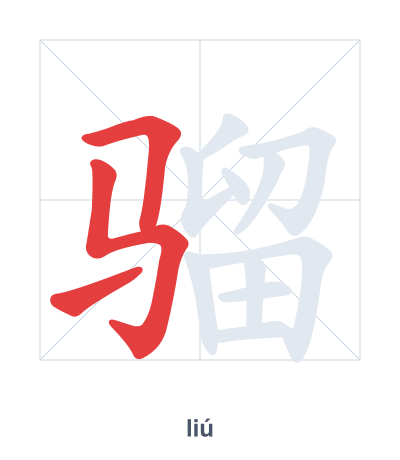
Open Hanzi Writer to see the animated stroke order and practice writing 骝 with real-time feedback.
The character 骝 (liú) is written with 13 strokes. Follow the standard Chinese stroke order: top to bottom, left to right, outside before inside. The radical 马 is one of its key components.
Practice the correct stroke order with the Hanzi Writer app to see animated stroke-by-stroke guidance with real-time feedback.
骝 means Bay horse (reddish-brown).
骝 is a phono-semantic compound combining the radical 马 (horse) with 留 (liú, 'to stay') as a phonetic component. The character specifically denotes a horse with a reddish-brown coat, often called a bay horse.
💡 Memory Tip: Imagine a bay-colored horse (马) that refuses to leave the stable—it decides to stay (留) right there.
骅骝是古代的名马。
huá liú shì gǔ dài de míng mǎ
Hualiu is a famous horse from ancient times.
那匹骝马跑得很快。
nà pǐ liú mǎ pǎo dé hěn kuài
That bay horse runs very fast.
紫骝在草地上奔跑。
zǐ liú zài cǎo dì shàng bēn pǎo
The bay horse is running on the grass.
Open Hanzi Writer to see the animated stroke order and practice writing 骝 with real-time feedback.
✨ Animated stroke order · Handwriting recognition · HSK-graded practice · Free to use
骝 is formed by the radical 马 (horse) on the left, which gives the meaning of horse, and the component 留 on the right, which provides the pronunciation liú. The right part does not directly contribute to the meaning but acts as a phonetic hint. Together, 骝 refers to a reddish-brown horse, a bay horse.