蒇 (chǎn) means "to complete / to finish" in Chinese. It has 12 strokes with the radical 艹.
Rated 4.2/5 in difficulty (advanced).
Appears in 3+ common words including 蒇事 (chǎn shì), 蒇功 (chǎn gōng), 蒇事大吉 (chǎn shì dà jí).
Due to its 12 strokes, Hanzi Writer's error detection shows 蒇 requires focused practice — most learners need 10+ attempts for consistent accuracy.
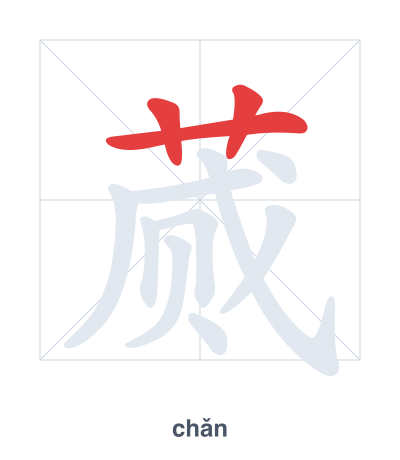
Open Hanzi Writer to see the animated stroke order and practice writing 蒇 with real-time feedback.
The character 蒇 (chǎn) is written with 12 strokes. Follow the standard Chinese stroke order: top to bottom, left to right, outside before inside. The radical 艹 is one of its key components.
Practice the correct stroke order with the Hanzi Writer app to see animated stroke-by-stroke guidance with real-time feedback.
蒇 means to complete / to finish.
蒇 is a phono-semantic compound where the grass radical (艹) hints at vegetation or a task like harvesting, and the component 戉 (a battle-axe) provides phonetic cues and symbolizes cutting or finishing an action. Together, they convey the idea of completing a task, such as clearing the last of the grass.
💡 Memory Tip: Picture a farmer using a battle-axe (戉) to chop the final tuft of grass (艹), thereby finishing his work.
此事已经蒇事。
cǐ shì yǐ jīng chǎn shì
This matter has been completed.
蒇功告成。
chǎn gōng gào chéng
The work is successfully completed.
希望能够蒇事大吉。
xī wàng néng gòu chǎn shì dà jí
I hope everything can be completed successfully.
Open Hanzi Writer to see the animated stroke order and practice writing 蒇 with real-time feedback.
✨ Animated stroke order · Handwriting recognition · HSK-graded practice · Free to use
蒇 is made of two parts: the radical 艹 (grass) on top and 咸 (xián, meaning 'all' or 'complete') below. The grass radical suggests plants or covering, while 咸 contributes the idea of fullness or completeness, together indicating finishing or completion.