蹩 (bié) means "to sprain; to limp; to be awkward" in Chinese. It has 18 strokes with the radical 足.
Rated 4.2/5 in difficulty (advanced).
Appears in 3+ common words including 蹩脚 (bié jiǎo), 蹩脚货 (bié jiǎo huò), 蹩气 (bié qì).
Due to its 18 strokes, Hanzi Writer's error detection shows 蹩 requires focused practice — most learners need 10+ attempts for consistent accuracy.
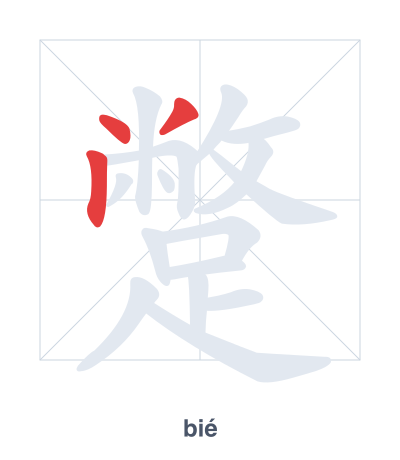
Open Hanzi Writer to see the animated stroke order and practice writing 蹩 with real-time feedback.
The character 蹩 (bié) is written with 18 strokes. Follow the standard Chinese stroke order: top to bottom, left to right, outside before inside. The radical 足 is one of its key components.
Practice the correct stroke order with the Hanzi Writer app to see animated stroke-by-stroke guidance with real-time feedback.
蹩 means to sprain; to limp; to be awkward.
蹩 combines 足 (foot) and 敝 (worn out, broken). The idea is a foot that is damaged or broken, leading to limping or a sprain. This compound character visually depicts the source of the awkwardness or injury in the foot.
💡 Memory Tip: Imagine a foot (足) with a cracked bone (like the 敝 component) that makes you limp awkwardly.
他的中文说得很蹩脚。
tā de zhōng wén shuō dé hěn bié jiǎo
He speaks very poor Chinese.
这是一件蹩脚货。
zhè shì yī jiàn bié jiǎo huò
This is a shoddy product.
这主意真让人蹩气。
zhè zhǔ yì zhēn ràng rén bié qì
This idea is really frustrating.
Open Hanzi Writer to see the animated stroke order and practice writing 蹩 with real-time feedback.
✨ Animated stroke order · Handwriting recognition · HSK-graded practice · Free to use
The character 蹩 combines the radical 足 (foot) on the left and 敝 (shabby or worn out) on the right. Together, they suggest a foot that is damaged or awkward, which leads to meanings like "to sprain" or "to limp." The 敝 component also carries a sense of being inferior, which extends to uses like 蹩脚 (clumsy, inferior).