镖 (biāo) means "dart or throwing knife" in Chinese. It has 16 strokes with the radical 钅.
Rated 4.2/5 in difficulty (advanced).
Appears in 3+ common words including 保镖 (bǎo biāo), 飞镖 (fēi biāo), 镖局 (biāo jú).
Due to its 16 strokes, Hanzi Writer's error detection shows 镖 requires focused practice — most learners need 10+ attempts for consistent accuracy.
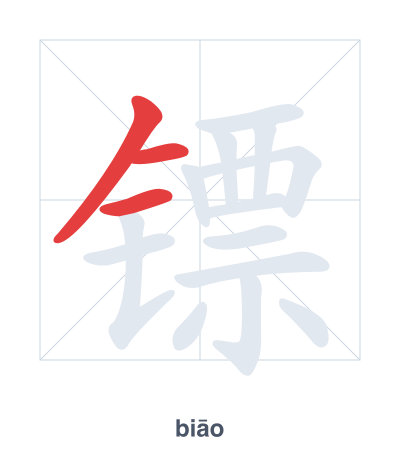
Open Hanzi Writer to see the animated stroke order and practice writing 镖 with real-time feedback.
The character 镖 (biāo) is written with 16 strokes. Follow the standard Chinese stroke order: top to bottom, left to right, outside before inside. The radical 钅 is one of its key components.
Practice the correct stroke order with the Hanzi Writer app to see animated stroke-by-stroke guidance with real-time feedback.
镖 means dart or throwing knife.
镖 is a phono-semantic compound: the radical 钅 (metal) signifies the material, and 票 (piào) provides the pronunciation while hinting at something that flies or is thrown, like a dart. The character combines these elements to depict a small metal weapon designed to be hurled at a target.
💡 Memory Tip: Imagine a metal dart (钅) with a ticket (票) tied to its tail, flying straight toward a bullseye.
他请了一个保镖保护他。
tā qǐng le yí gè bǎo biāo bǎo hù tā
He hired a bodyguard to protect him.
我们一起去玩飞镖吧。
wǒ men yì qǐ qù wán fēi biāo ba
Let's go play darts together.
古代有很多镖局。
gǔ dài yǒu hěn duō biāo jú
There were many security bureaus in ancient times.
Open Hanzi Writer to see the animated stroke order and practice writing 镖 with real-time feedback.
✨ Animated stroke order · Handwriting recognition · HSK-graded practice · Free to use
镖 is made of two parts: the left side 钅 (metal radical) and the right side 票 (piào, meaning ticket or certificate). The metal radical hints that a 镖 is a metal object, such as a dart or throwing knife, while 票 may historically relate to a marked target or a token used in escort services.