镚 (bèng) means "small coin" in Chinese. It has 16 strokes with the radical 钅.
Rated 4.2/5 in difficulty (advanced).
Appears in 3+ common words including 钢镚儿 (gāng bèng er), 镚子 (bèng zi), 一镚儿 (yī bèng ér).
Due to its 16 strokes, Hanzi Writer's error detection shows 镚 requires focused practice — most learners need 10+ attempts for consistent accuracy.
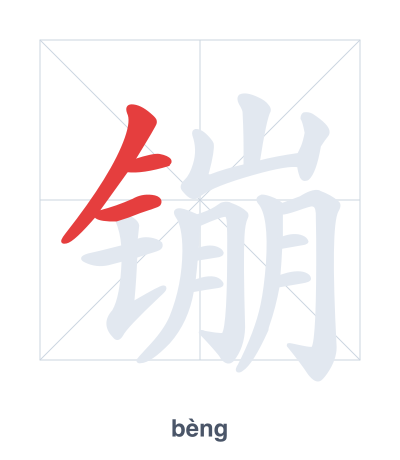
Open Hanzi Writer to see the animated stroke order and practice writing 镚 with real-time feedback.
The character 镚 (bèng) is written with 16 strokes. Follow the standard Chinese stroke order: top to bottom, left to right, outside before inside. The radical 钅 is one of its key components.
Practice the correct stroke order with the Hanzi Writer app to see animated stroke-by-stroke guidance with real-time feedback.
镚 means small coin.
镚 is a phono-semantic compound; the radical 钅 (metal) indicates it relates to coins, while 崩 (bēng, meaning 'collapse') provides the pronunciation and suggests the small coin's low value—something minor that could easily be lost or crumble away.
💡 Memory Tip: Imagine a tiny metal coin (钅) that is so worthless it makes a whole mountain (山) collapse (崩) in disappointment.
兜里有几个钢镚儿。
dōu lǐ yǒu jǐ gè gāng bèng er
There are a few coins in the pocket.
他给了我一个镚子。
tā gěi le wǒ yí gè bèng zi
He gave me a coin.
他一镚儿钱也没有。
tā yī bèng ér qián yě méi yǒu
He doesn't have a single penny.
Open Hanzi Writer to see the animated stroke order and practice writing 镚 with real-time feedback.
✨ Animated stroke order · Handwriting recognition · HSK-graded practice · Free to use
镚 is made of the radical 钍 (metal) on the left and the phonetic component 崩 on the right. The metal radical shows that the character relates to money or metal objects, and the right part gives the pronunciation bèng. Together, they create the meaning "small coin," which is a small metal object.