驼 (tuó) means "camel; humpbacked" in Chinese. It has 8 strokes with the radical 马.
Rated 3.7/5 in difficulty (challenging).
Appears in 3+ common words including 骆驼 (luò tuó), 驼背 (tuó bèi), 驼色 (tuó sè).
Due to its 8 strokes, Hanzi Writer's error detection shows 驼 requires focused practice — most learners need 10+ attempts for consistent accuracy.
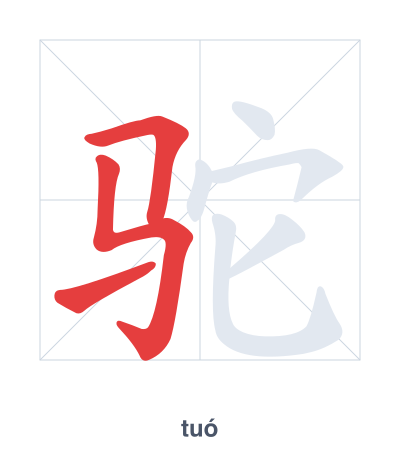
Open Hanzi Writer to see the animated stroke order and practice writing 驼 with real-time feedback.
The character 驼 (tuó) is written with 8 strokes. Follow the standard Chinese stroke order: top to bottom, left to right, outside before inside. The radical 马 is one of its key components.
Practice the correct stroke order with the Hanzi Writer app to see animated stroke-by-stroke guidance with real-time feedback.
驼 means camel; humpbacked.
驼 combines the radical 马 (horse) with 它 (tā, 'it' or 'other'), indicating a horse-like animal with a distinctive hump—the camel. The 它 component also hints at the pronunciation tuó.
💡 Memory Tip: Imagine a horse (马) growing a giant hump on its back (like the curvy top of 它) and plodding through the desert as a camel.
沙漠里有很多骆驼。
shā mò lǐ yǒu hěn duō luò tuó
There are many camels in the desert.
那个老人有点驼背。
nà ge lǎo rén yǒu diǎn tuó bèi
That old man is a bit hunchbacked.
我买了一件驼色的大衣。
wǒ mǎi le yī jiàn tuó sè de dà yī
I bought a camel-colored coat.
Open Hanzi Writer to see the animated stroke order and practice writing 驼 with real-time feedback.
✨ Animated stroke order · Handwriting recognition · HSK-graded practice · Free to use
The left part 马 is the radical for horse, indicating that this character relates to an animal. The right part 它 provides the pronunciation "tuó" and does not carry meaning. Together, they form the character for camel, a large animal often compared to a horse with humps.