揞 (ǎn) means "to cover with the hand" in Chinese. It has 12 strokes with the radical 扌.
Rated 4.2/5 in difficulty (advanced).
Appears in 3+ common words including 揞住 (ǎn zhù), 揞着 (ǎn zhe), 揞药 (ǎn yào).
Due to its 12 strokes, Hanzi Writer's error detection shows 揞 requires focused practice — most learners need 10+ attempts for consistent accuracy.
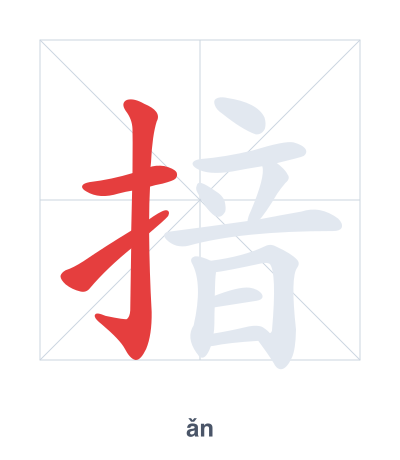
Open Hanzi Writer to see the animated stroke order and practice writing 揞 with real-time feedback.
The character 揞 (ǎn) is written with 12 strokes. Follow the standard Chinese stroke order: top to bottom, left to right, outside before inside. The radical 扌 is one of its key components.
Practice the correct stroke order with the Hanzi Writer app to see animated stroke-by-stroke guidance with real-time feedback.
揞 means to cover with the hand.
揞 combines the hand radical 扌 with 音 (sound), suggesting covering with the hand to muffle or block sound. This reflects the meaning 'to cover with the hand'—like pressing a hand over a mouth or ear to silence noise.
💡 Memory Tip: Picture a hand (扌) clamping over a musical note (音) to mute its sound.
他用手揞住伤口。
tā yòng shǒu ǎn zhù shāng kǒu
He pressed his hand against the wound.
她揞着口袋走开了。
tā ǎn zhe kǒu dài zǒu kāi le
She walked away clutching her pocket.
医生在给他揞药。
yī shēng zài gěi tā ǎn yào
The doctor is applying ointment to him.
Open Hanzi Writer to see the animated stroke order and practice writing 揞 with real-time feedback.
✨ Animated stroke order · Handwriting recognition · HSK-graded practice · Free to use
揞 is made of the radical 扌 (hand) on the left and the character 安 (ān, meaning 'peace' or 'safe') on the right. The hand radical shows the action is done with the hand, while 安 provides the pronunciation and suggests a gentle pressing motion. Together, they mean 'to cover with the hand'.