伫 (zhù) means "To stand for a long time." in Chinese. It has 6 strokes with the radical 亻.
Rated 2.9/5 in difficulty (moderate).
Appears in 3+ common words including 伫立 (zhù lì), 伫候 (zhù hòu), 伫望 (zhù wàng).
Hanzi Writer's stroke validation shows learners typically need 5-8 attempts to write 伫 with correct proportion and order.
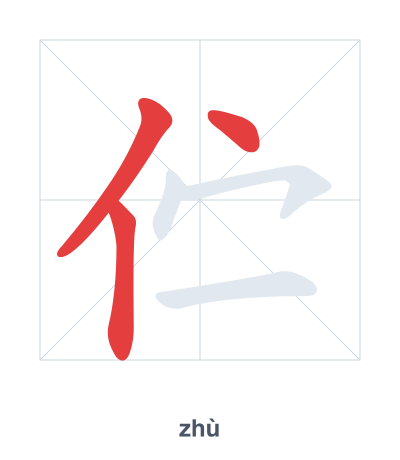
Open Hanzi Writer to see the animated stroke order and practice writing 伫 with real-time feedback.
The character 伫 (zhù) is written with 6 strokes. Follow the standard Chinese stroke order: top to bottom, left to right, outside before inside. The radical 亻 is one of its key components.
Practice the correct stroke order with the Hanzi Writer app to see animated stroke-by-stroke guidance with real-time feedback.
伫 means To stand for a long time..
The character 伫 combines the person radical 亻 with 宁 (zhù), which originally depicted a storage space or container. Together, they suggest a person standing still for a long time, as if storing themselves in one spot. Its meaning of prolonged standing also carries a sense of patient waiting or unwavering presence.
💡 Memory Tip: Imagine a person (亻) standing so still for hours that they turn into a storage box (宁) filled with time.
他在江边伫立良久。
tā zài jiāng biān zhù lì liáng jiǔ
He stood by the river for a long time.
我在此伫候佳音。
wǒ zài cǐ zhù hòu jiā yīn
I am waiting here for good news.
他向远方伫望。
tā xiàng yuǎn fāng zhù wàng
He gazed into the distance.
Open Hanzi Writer to see the animated stroke order and practice writing 伫 with real-time feedback.
✨ Animated stroke order · Handwriting recognition · HSK-graded practice · Free to use
伫 is made of the person radical 亻 on the left and the component 宁 on the right. The 亻 shows that the meaning is about a person, while 宁 gives a pronunciation hint (zhù). Together, they suggest a person standing still for a long time.