诛 (zhū) means "to execute; to punish" in Chinese. It has 8 strokes with the radical 讠.
Rated 3.4/5 in difficulty (challenging).
Appears in 3+ common words including 诛心 (zhū xīn), 伏诛 (fú zhū), 诛求 (zhū qiú).
Due to its 8 strokes, Hanzi Writer's error detection shows 诛 requires focused practice — most learners need 10+ attempts for consistent accuracy.
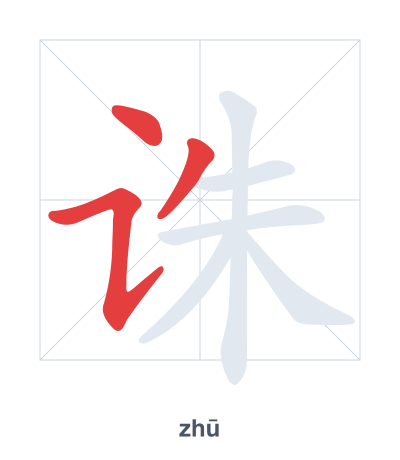
Open Hanzi Writer to see the animated stroke order and practice writing 诛 with real-time feedback.
The character 诛 (zhū) is written with 8 strokes. Follow the standard Chinese stroke order: top to bottom, left to right, outside before inside. The radical 讠 is one of its key components.
Practice the correct stroke order with the Hanzi Writer app to see animated stroke-by-stroke guidance with real-time feedback.
诛 means to execute; to punish.
诛 combines the radical 讠 (speech/words) with 朱 (zhū, red), which hints at the idea of a verbal condemnation that leads to bloodshed. Originally it meant to denounce or rebuke verbally, but later evolved to mean 'to execute' or 'to punish' as a formal death sentence pronounced by authority.
💡 Memory Tip: Picture a judge's speech bubble (讠) turning blood-red (朱) as it declares the execution.
这句话太诛心了。
zhè jù huà tài zhū xīn le
This remark is too cutting and malicious.
坏人最终伏诛了。
huài rén zuì zhōng fú zhū le
The villain was finally brought to justice.
这种诛求不合理。
zhè zhǒng zhū qiú bù hé lǐ
This extortionate demand is unreasonable.
Open Hanzi Writer to see the animated stroke order and practice writing 诛 with real-time feedback.
✨ Animated stroke order · Handwriting recognition · HSK-graded practice · Free to use
The character 诛 is composed of the radical 讠 (speech) on the left and 朱 (red) on the right. The speech radical indicates that the character involves words or judgment, suggesting a formal condemnation. Together, they imply a verbal sentence of punishment or execution.