摭 (zhí) means "to pick up" in Chinese. It has 14 strokes with the radical 扌.
Rated 4.2/5 in difficulty (advanced).
Appears in 3+ common words including 采摭 (cǎi zhí), 摭拾 (zhí shí), 摭取 (zhí qǔ).
Due to its 14 strokes, Hanzi Writer's error detection shows 摭 requires focused practice — most learners need 10+ attempts for consistent accuracy.
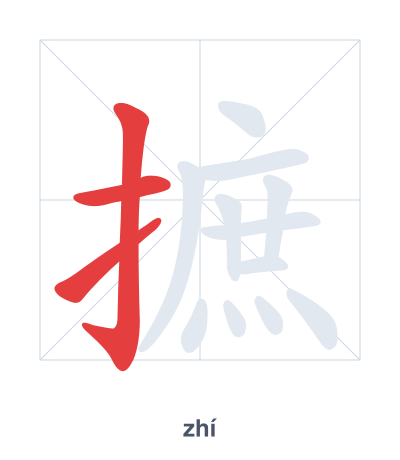
Open Hanzi Writer to see the animated stroke order and practice writing 摭 with real-time feedback.
The character 摭 (zhí) is written with 14 strokes. Follow the standard Chinese stroke order: top to bottom, left to right, outside before inside. The radical 扌 is one of its key components.
Practice the correct stroke order with the Hanzi Writer app to see animated stroke-by-stroke guidance with real-time feedback.
摭 means to pick up.
摭 is a phono-semantic compound. Its left component 扌 (hand) indicates the action of picking up, while the right component 庶 (shù) originally meant 'numerous' or 'cook' and provides a rough phonetic cue. Together, the character visually suggests using one's hand to gather many items.
💡 Memory Tip: Picture a hand (扌) reaching under a shelter (广) to pick up twenty (廿) fiery coals (火) one by one.
他在采摭素材。
tā zài cǎi zhí sù cái
He is collecting materials.
孩子在摭拾树叶。
hái zi zài zhí shí shù yè
The child is picking up fallen leaves.
写作要摭取生活。
xiě zuò yào zhí qǔ shēng huó
Writing should draw from life.
Open Hanzi Writer to see the animated stroke order and practice writing 摭 with real-time feedback.
✨ Animated stroke order · Handwriting recognition · HSK-graded practice · Free to use
The left part 扌 means "hand," indicating the action is done with the hand. The right part 庶 gives the pronunciation zhí and also suggests the idea of gathering many things, so together the character means "to pick up" or "collect."