姪 (zhí) means "nephew; niece" in Chinese. It has 9 strokes with the radical 女.
Rated 4/5 in difficulty (challenging).
Appears in 3+ common words including 姪子 (zhí zi), 姪女 (zhí nǚ), 贤姪 (xián zhí).
Due to its 9 strokes, Hanzi Writer's error detection shows 姪 requires focused practice — most learners need 10+ attempts for consistent accuracy.
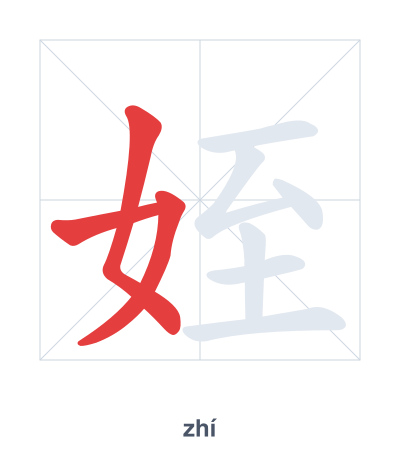
Open Hanzi Writer to see the animated stroke order and practice writing 姪 with real-time feedback.
The character 姪 (zhí) is written with 9 strokes. Follow the standard Chinese stroke order: top to bottom, left to right, outside before inside. The radical 女 is one of its key components.
Practice the correct stroke order with the Hanzi Writer app to see animated stroke-by-stroke guidance with real-time feedback.
姪 means nephew; niece.
姪 is a compound character with the radical 女 (woman, female) on the left and 至 (arrive) as a phonetic component. Originally it referred to a brother's daughter (niece), with the female radical indicating the child's gender, though in modern usage it can mean both nephew and niece. The phonetic 至 hints at the idea of a child 'arriving' into the extended family through a sibling's bloodline.
💡 Memory Tip: Picture a woman (女) standing at a doorstep as a child 'arrives' (至), greeting her nephew or niece.
我姪子在读小学。
wǒ zhí zi zài dú xiǎo xué
My nephew is in elementary school.
姪女送我一幅画。
zhí nǚ sòng wǒ yī fú huà
My niece gave me a painting.
贤姪最近好吗?
xián zhí zuì jìn hǎo ma
How have you been lately, my dear nephew?
Open Hanzi Writer to see the animated stroke order and practice writing 姪 with real-time feedback.
✨ Animated stroke order · Handwriting recognition · HSK-graded practice · Free to use
The left part is 女 (woman), indicating this character relates to female family members. The right part is 至 (zhì), which gives the pronunciation zhí and together they refer to a brother's child, either a nephew or niece.