戠 (zhī) means "To record; pottery clay." in Chinese. It has 13 strokes with the radical 戈.
Rated 4.2/5 in difficulty (advanced).
Appears in 3+ common words including 戠戠 (zhī zhī), 戠理 (zhī lǐ), 古戠 (gǔ zhī).
Due to its 13 strokes, Hanzi Writer's error detection shows 戠 requires focused practice — most learners need 10+ attempts for consistent accuracy.
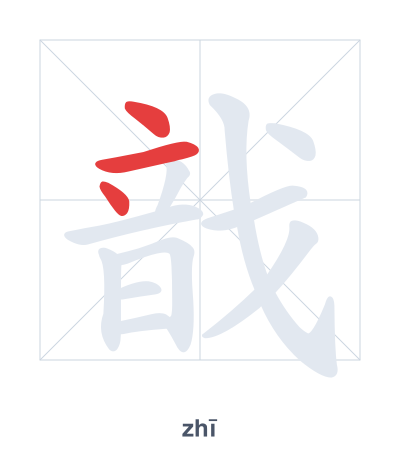
Open Hanzi Writer to see the animated stroke order and practice writing 戠 with real-time feedback.
The character 戠 (zhī) is written with 13 strokes. Follow the standard Chinese stroke order: top to bottom, left to right, outside before inside. The radical 戈 is one of its key components.
Practice the correct stroke order with the Hanzi Writer app to see animated stroke-by-stroke guidance with real-time feedback.
戠 means To record; pottery clay..
戠 combines 戈 (spear, a tool) and 音 (sound/music), suggesting the act of carving or marking sounds onto pottery clay. The spear-like tool was used to inscribe records, linking to the meanings 'to record' and 'pottery clay.'
💡 Memory Tip: Imagine a spear (戈) poking into wet clay while singing a sound (音) to record it—a musical archaeology.
这个字读作戠戠。
zhè ge zì dú zuò zhī zhī
This character is pronounced 'zhí zhí'.
他在研究戠理。
tā zài yán jiū zhī lǐ
He is studying the principles of patterns and textures.
这是古书里的戠字。
zhè shì gǔ shū lǐ de zhī zì
This is the character 'zhi' in ancient books.
Open Hanzi Writer to see the animated stroke order and practice writing 戠 with real-time feedback.
✨ Animated stroke order · Handwriting recognition · HSK-graded practice · Free to use
The character 戠 consists of the radical 戈 (spear or weapon) on the right and a phonetic component on the left. The left part is 埶 (yì) which originally related to planting or pottery, linking the character to clay. Together, they suggest the idea of using a tool to record or shape clay, giving the meanings "to record" and "pottery clay."