狰 (zhēng) means "ferocious" in Chinese. It has 9 strokes with the radical 犭.
Rated 4/5 in difficulty (challenging).
Appears in 3+ common words including 狰狞 (zhēng níng), 狰狞可怖 (zhēng níng kě bù), 狰狞面目 (zhēng níng miàn mù).
Due to its 9 strokes, Hanzi Writer's error detection shows 狰 requires focused practice — most learners need 10+ attempts for consistent accuracy.
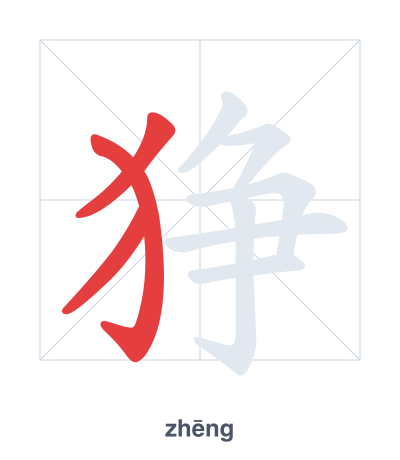
Open Hanzi Writer to see the animated stroke order and practice writing 狰 with real-time feedback.
The character 狰 (zhēng) is written with 9 strokes. Follow the standard Chinese stroke order: top to bottom, left to right, outside before inside. The radical 犭 is one of its key components.
Practice the correct stroke order with the Hanzi Writer app to see animated stroke-by-stroke guidance with real-time feedback.
狰 means ferocious.
The character 狰 combines the radical 犭 (beast/dog) on the left with 争 (zhēng, 'strive, struggle') on the right. This compound suggests a beast that is fiercely struggling or fighting, hence 'ferocious'.
💡 Memory Tip: Picture a savage beast (犭) locked in a violent struggle (争) with its prey, baring its teeth in ferocious fury.
他的面目很狰狞。
tā de miàn mù hěn zhēng níng
His face looks very hideous.
样子看起来狰狞可怖。
yàng zi kàn qǐ lái zhēng níng kě bù
The appearance looks hideous and terrifying.
露出狰狞面目。
lù chū zhēng níng miàn mù
To reveal one's hideous features.
Open Hanzi Writer to see the animated stroke order and practice writing 狰 with real-time feedback.
✨ Animated stroke order · Handwriting recognition · HSK-graded practice · Free to use
The character 狰 combines the radical 犭 (dog/beast) on the left, indicating an animal, with the phonetic component 争 on the right. The radical suggests a fierce beast, reinforcing the meaning 'ferocious' or 'hideous'.