赃 (zāng) means "stolen goods; booty" in Chinese. It has 10 strokes with the radical 贝, and is HSK Level 7.
Rated 4.2/5 in difficulty (advanced).
Harder than 90% of HSK Level 7 characters.
Appears in 3+ common words including 赃物 (zāng wù), 赃款 (zāng kuǎn), 销赃 (xiāo zāng).
Due to its 10 strokes, Hanzi Writer's error detection shows 赃 requires focused practice — most learners need 10+ attempts for consistent accuracy.
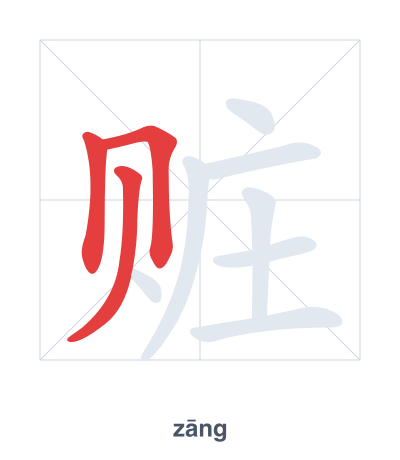
Open Hanzi Writer to see the animated stroke order and practice writing 赃 with real-time feedback.
The character 赃 (zāng) is written with 10 strokes. Follow the standard Chinese stroke order: top to bottom, left to right, outside before inside. The radical 贝 is one of its key components.
Practice the correct stroke order with the Hanzi Writer app to see animated stroke-by-stroke guidance with real-time feedback.
赃 means stolen goods; booty.
As an HSK Level 7 character, 赃 is an intermediate-level character.
赃 is a phono-semantic compound: the left radical 贝 (shell, ancient money) indicates connection to wealth or property, while the right component 庄 provides the pronunciation zhuāng. Together, they depict ill-gotten money or goods, i.e., stolen booty.
💡 Memory Tip: Picture a thief hiding a pile of stolen shells (贝) inside a village storehouse (庄, with roof 广 over earth 土) to remember 赃 as stolen goods.
警察找到了被偷的赃物。
jǐng chá zhǎo dào le bèi tōu de zāng wù
The police found the stolen goods.
他必须退还所有赃款。
tā bì xū tuì huán suǒ yǒu zāng kuǎn
He must return all the stolen money.
小偷正在到处销赃。
xiǎo tōu zhèng zài dào chù xiāo zāng
The thief is selling stolen goods everywhere.
Open Hanzi Writer to see the animated stroke order and practice writing 赃 with real-time feedback.
✨ Animated stroke order · Handwriting recognition · HSK-graded practice · Free to use
The character 赃 has the radical 贝 (shell, money) on the left, which shows it is about money or property. The right part is 庄 (zhuāng, village or farm), which gives a hint to the pronunciation. Together, 赃 means ill-gotten goods or stolen money.