糌 (zān) means "Tsampa" in Chinese. It has 15 strokes with the radical 米.
Rated 4.2/5 in difficulty (advanced).
Appears in 3+ common words including 糌粑 (zān bā), 吃糌粑 (chī zān bā), 做糌粑 (zuò zān bā).
Due to its 15 strokes, Hanzi Writer's error detection shows 糌 requires focused practice — most learners need 10+ attempts for consistent accuracy.
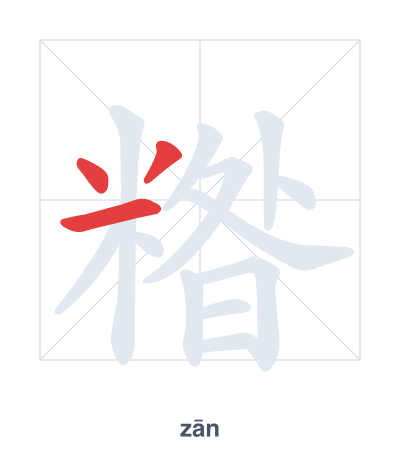
Open Hanzi Writer to see the animated stroke order and practice writing 糌 with real-time feedback.
The character 糌 (zān) is written with 15 strokes. Follow the standard Chinese stroke order: top to bottom, left to right, outside before inside. The radical 米 is one of its key components.
Practice the correct stroke order with the Hanzi Writer app to see animated stroke-by-stroke guidance with real-time feedback.
糌 means Tsampa.
This character is a phono-semantic compound: the left radical 米 (rice/grain) indicates the food category, and the right component 朁 (zān) provides the pronunciation. Tsampa is a Tibetan staple made from roasted barley flour, so the grain radical links it to the meaning.
💡 Memory Tip: Picture a Tibetan monk (朁 resembling a robed figure) stirring a bowl of roasted barley flour (米) to prepare tsampa dough.
糌粑很好吃。
zān bā hěn hǎo chī
Tsampa is very delicious.
他在吃糌粑。
tā zài chī zān bā
He is eating tsampa.
奶奶在做糌粑。
nǎi nǎi zài zuò zān bā
Grandma is making tsampa.
Open Hanzi Writer to see the animated stroke order and practice writing 糌 with real-time feedback.
✨ Animated stroke order · Handwriting recognition · HSK-graded practice · Free to use
糌 is composed of the radical 米 (rice/grain) on the left and the phonetic component 昝 on the right. The radical 米 indicates that the character relates to grain-based food, which matches tsampa (roasted barley flour). The right part 昝 provides the pronunciation zān and does not contribute much to the meaning.