哉 (zāi) means "(exclamatory particle)" in Chinese. It has 9 strokes with the radical 口.
Rated 4/5 in difficulty (challenging).
Appears in 3+ common words including 悠哉 (yōu zāi), 快哉 (kuài zāi), 善哉 (shàn zāi).
Due to its 9 strokes, Hanzi Writer's error detection shows 哉 requires focused practice — most learners need 10+ attempts for consistent accuracy.
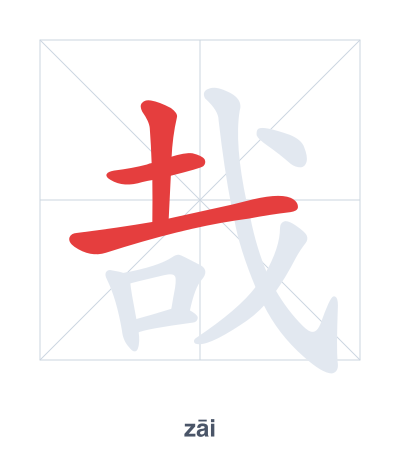
Open Hanzi Writer to see the animated stroke order and practice writing 哉 with real-time feedback.
The character 哉 (zāi) is written with 9 strokes. Follow the standard Chinese stroke order: top to bottom, left to right, outside before inside. The radical 口 is one of its key components.
Practice the correct stroke order with the Hanzi Writer app to see animated stroke-by-stroke guidance with real-time feedback.
哉 means (exclamatory particle).
哉 combines 口 (mouth, for speech) and 戈 (spear, possibly as a phonetic element with ancient pronunciation). The mouth suggests the character is used for exclamatory sounds, like a shout or cry in classical Chinese.
💡 Memory Tip: Imagine a warrior with a spear (戈) throwing his head back and opening his mouth (口) wide to yell "Zai!" as a battle cry.
他过得很悠哉。
tā guò dé hěn yōu zāi
He lives a very leisurely life.
真是快哉!
zhēn shì kuài zāi
How delightful!
善哉,善哉。
shàn zāi shàn zāi
Very good, very good.
Open Hanzi Writer to see the animated stroke order and practice writing 哉 with real-time feedback.
✨ Animated stroke order · Handwriting recognition · HSK-graded practice · Free to use
哉 combines the radical 口 (mouth, for sounds/exclamations) with the phonetic component 咍 (though simplified to 戉-like shape). The 口 radical indicates it is an exclamatory particle, while the rest contributes to pronunciation. Together, they form a character used to express strong emotion or admiration in classical Chinese style.