臜 (zā) means "dirty; filthy" in Chinese. It has 20 strokes with the radical 月.
Rated 3.8/5 in difficulty (challenging).
Appears in 3+ common words including 腌臜 (ā zā), 臜东西 (zā dōng xī), 臜气 (zā qì).
Due to its 20 strokes, Hanzi Writer's error detection shows 臜 requires focused practice — most learners need 10+ attempts for consistent accuracy.
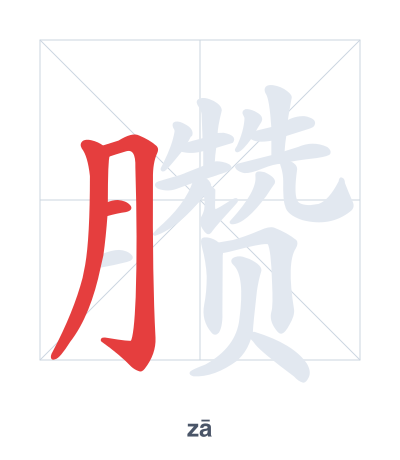
Open Hanzi Writer to see the animated stroke order and practice writing 臜 with real-time feedback.
The character 臜 (zā) is written with 20 strokes. Follow the standard Chinese stroke order: top to bottom, left to right, outside before inside. The radical 月 is one of its key components.
Practice the correct stroke order with the Hanzi Writer app to see animated stroke-by-stroke guidance with real-time feedback.
臜 means dirty; filthy.
臜 is a compound character with the meat radical 月 (flesh) and the phonetic component 赞 (zàn, 'to praise'). The meaning 'dirty' likely comes from the idea of tainted or filthy meat, as the radical suggests a bodily or fleshy context.
💡 Memory Tip: Imagine a piece of meat (月) covered in 20 dirty fingerprints, and despite someone praising (赞) it, it's still filthy.
这件衣服真腌臜。
zhè jiàn yī fú zhēn ā zā
This piece of clothing is really filthy.
别碰那些臜东西。
bié pèng nà xiē zā dōng xī
Don't touch those filthy things.
这里到处是臜气。
zhè lǐ dào chù shì zā qì
There is a foul smell everywhere here.
Open Hanzi Writer to see the animated stroke order and practice writing 臜 with real-time feedback.
✨ Animated stroke order · Handwriting recognition · HSK-graded practice · Free to use
The character 臜 is composed of the radical 月 (flesh or body) on the left and the component 赞 (zàn) on the right. The radical 月 suggests a connection to the body, and together with the right part, the character conveys the idea of bodily filth or dirtiness.