橼 (yuán) means "citron" in Chinese. It has 16 strokes with the radical 木.
Rated 4.2/5 in difficulty (advanced).
Appears in 3+ common words including 香橼 (xiāng yuán), 橼皮 (yuán pí), 佛手橼 (fó shǒu yuán).
Due to its 16 strokes, Hanzi Writer's error detection shows 橼 requires focused practice — most learners need 10+ attempts for consistent accuracy.
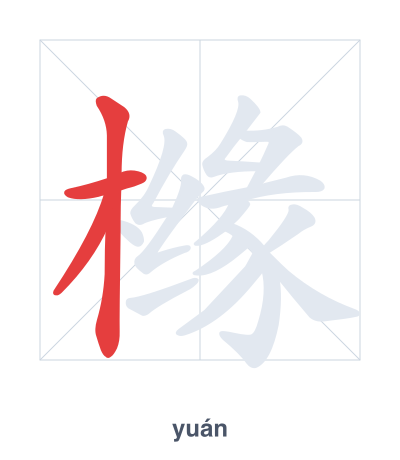
Open Hanzi Writer to see the animated stroke order and practice writing 橼 with real-time feedback.
The character 橼 (yuán) is written with 16 strokes. Follow the standard Chinese stroke order: top to bottom, left to right, outside before inside. The radical 木 is one of its key components.
Practice the correct stroke order with the Hanzi Writer app to see animated stroke-by-stroke guidance with real-time feedback.
橼 means citron.
橼 is a phono-semantic compound: the radical 木 (tree) indicates it is a type of tree, while 缘 (yuán) provides the pronunciation. This character specifically refers to the citron tree, which produces large, fragrant citrus fruits.
💡 Memory Tip: Picture a tree (木) with a silken ribbon (纟) tied around a pig’s snout (彖) – that odd, bumpy fruit is a citron, and only fate (缘) brings you to it.
香橼的味道很香。
xiāng yuán de wèi dào hěn xiāng
The citron has a very fragrant scent.
橼皮可以入药。
yuán pí kě yǐ rù yào
Citron peel can be used as medicine.
佛手橼长得很奇怪。
fó shǒu yuán zhǎng dé hěn qí guài
The Buddha's hand citron looks very strange.
Open Hanzi Writer to see the animated stroke order and practice writing 橼 with real-time feedback.
✨ Animated stroke order · Handwriting recognition · HSK-graded practice · Free to use
The character 橼 has the radical 木 (tree/wood) on the left, showing it relates to trees or plants. The right part 爰 (yuán) gives the sound and also hints at the fruit’s round shape. Together, 木 + 爰 means "citron tree" – a tree that produces the round, fragrant citron fruit.