爬 (pá) means "To climb / To crawl" in Chinese. It has 8 strokes with the radical 爪, and is HSK Level 2.
Rated 3.2/5 in difficulty (challenging).
Harder than 51% of HSK Level 2 characters.
Appears in 3+ common words including 爬山 (pá shān), 爬行 (pá xíng), 爬树 (pá shù).
Due to its 8 strokes, Hanzi Writer's error detection shows 爬 requires focused practice — most learners need 10+ attempts for consistent accuracy.
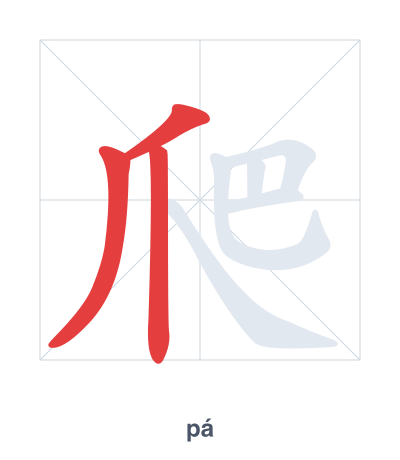
Open Hanzi Writer to see the animated stroke order and practice writing 爬 with real-time feedback.
The character 爬 (pá) is written with 8 strokes. Follow the standard Chinese stroke order: top to bottom, left to right, outside before inside. The radical 爪 is one of its key components.
Practice the correct stroke order with the Hanzi Writer app to see animated stroke-by-stroke guidance with real-time feedback.
爬 means To climb / To crawl.
As an HSK Level 2 character, 爬 is among the first characters beginners learn.
The character 爬 combines the radical 爪 (claw/hand) with 巴, which originally depicted a snake and now serves as a phonetic hint (pronounced bā). Together, the claw gripping a snake-like form suggests the motion of clinging and pulling oneself upward, conveying the meaning to climb or crawl.
💡 Memory Tip: Imagine a huge claw (爪) grabbing a snake (巴) and slowly pulling itself up a tree branch, inching forward to climb higher.
我们明天去爬山。
wǒ men míng tiān qù pá shān
We are going hiking tomorrow.
乌龟在地上爬行。
wū guī zài dì shàng pá xíng
The turtle is crawling on the ground.
小猴子在爬树。
xiǎo hóu zi zài pá shù
The little monkey is climbing a tree.
Open Hanzi Writer to see the animated stroke order and practice writing 爬 with real-time feedback.
✨ Animated stroke order · Handwriting recognition · HSK-graded practice · Free to use
爬 is made of two parts: the radical 爪 (claw/hand) on top and 巴 (bā) below. The claw radical suggests using hands or claws to move upward, while 巴 provides pronunciation. Together, they create the idea of climbing or crawling using claws or hands.