蛹 (yǒng) means "Pupa / Chrysalis" in Chinese. It has 13 strokes with the radical 虫.
Rated 4.2/5 in difficulty (advanced).
Appears in 3+ common words including 蚕蛹 (cán yǒng), 化蛹 (huà yǒng), 蛹期 (yǒng qī).
Due to its 13 strokes, Hanzi Writer's error detection shows 蛹 requires focused practice — most learners need 10+ attempts for consistent accuracy.
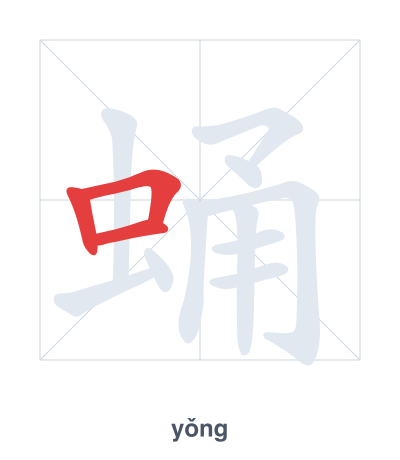
Open Hanzi Writer to see the animated stroke order and practice writing 蛹 with real-time feedback.
The character 蛹 (yǒng) is written with 13 strokes. Follow the standard Chinese stroke order: top to bottom, left to right, outside before inside. The radical 虫 is one of its key components.
Practice the correct stroke order with the Hanzi Writer app to see animated stroke-by-stroke guidance with real-time feedback.
蛹 means Pupa / Chrysalis.
This character is a phono-semantic compound: the radical 虫 (insect) indicates its meaning, while the component 甬 (yǒng) provides the pronunciation and originally depicted a narrow passage or tube—evoking the tight enclosure of a pupa or chrysalis during metamorphosis.
💡 Memory Tip: Picture an insect (虫) sealed inside a narrow tube (甬), wiggling as it transforms into a pupa.
蚕蛹很有营养。
cán yǒng hěn yǒu yíng yǎng
Silkworm pupae are very nutritious.
毛毛虫正在化蛹。
máo máo chóng zhèng zài huà yǒng
The caterpillar is turning into a chrysalis.
这是昆虫的蛹期。
zhè shì kūn chóng de yǒng qī
This is the pupal stage of an insect.
Open Hanzi Writer to see the animated stroke order and practice writing 蛹 with real-time feedback.
✨ Animated stroke order · Handwriting recognition · HSK-graded practice · Free to use
蛹 is composed of the radical 虫 (insect/worm) on the left and 甬 (yǒng) on the right. The 虫 radical indicates that the character relates to insects, and 甬 provides the pronunciation. Together, they represent the pupal stage of insects like butterflies or silkworms.