胰 (yí) means "pancreas" in Chinese. It has 10 strokes with the radical 月.
Rated 4.2/5 in difficulty (advanced).
Appears in 3+ common words including 胰腺 (yí xiàn), 胰岛素 (yí dǎo sù), 胰液 (yí yè).
Due to its 10 strokes, Hanzi Writer's error detection shows 胰 requires focused practice — most learners need 10+ attempts for consistent accuracy.
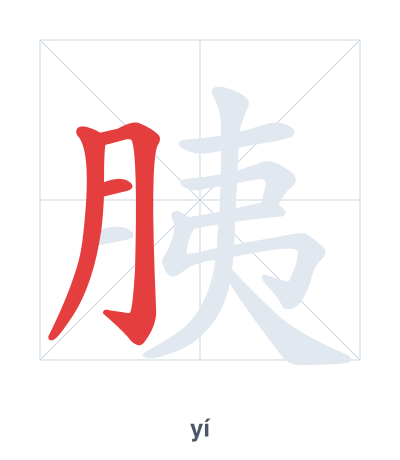
Open Hanzi Writer to see the animated stroke order and practice writing 胰 with real-time feedback.
The character 胰 (yí) is written with 10 strokes. Follow the standard Chinese stroke order: top to bottom, left to right, outside before inside. The radical 月 is one of its key components.
Practice the correct stroke order with the Hanzi Writer app to see animated stroke-by-stroke guidance with real-time feedback.
胰 means pancreas.
The character 胰 combines the radical 月 (flesh, indicating a body part) with 夷 (yí, serving as a phonetic component meaning 'level' or 'barbarian'). Together they represent a fleshy internal organ, the pancreas.
💡 Memory Tip: Picture a barbarian (夷) with a fleshy (月) pancreas shaped like a flat, level sword.
胰腺分泌消化液。
yí xiàn fēn mì xiāo huà yè
The pancreas secretes digestive juices.
糖尿病患者需要胰岛素。
táng niào bìng huàn zhě xū yào yí dǎo sù
Diabetic patients need insulin.
胰液有助于食物消化。
yí yè yǒu zhù yú shí wù xiāo huà
Pancreatic juice helps with food digestion.
Open Hanzi Writer to see the animated stroke order and practice writing 胰 with real-time feedback.
✨ Animated stroke order · Handwriting recognition · HSK-graded practice · Free to use
The left side is 月, the radical for flesh or body parts, indicating the character relates to an organ. The right side is 夷 (yí), which provides the pronunciation and originally meant "to level" or "barbarian," but here it acts as a phonetic component. Together, 胰 refers to the pancreas, an organ in the body.