俨 (yǎn) means "majestic, dignified, or as if" in Chinese. It has 9 strokes with the radical 亻.
Rated 3.7/5 in difficulty (challenging).
Appears in 3+ common words including 俨然 (yǎn rán), 俨如 (yǎn rú), 庄俨 (zhuāng yǎn).
Due to its 9 strokes, Hanzi Writer's error detection shows 俨 requires focused practice — most learners need 10+ attempts for consistent accuracy.
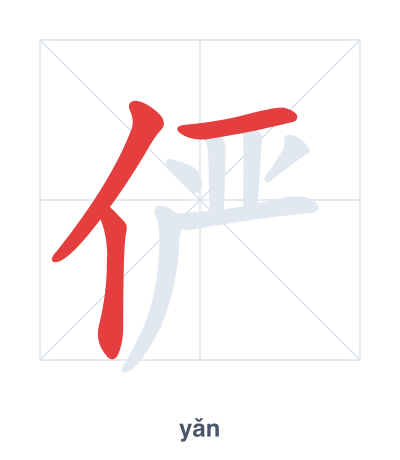
Open Hanzi Writer to see the animated stroke order and practice writing 俨 with real-time feedback.
The character 俨 (yǎn) is written with 9 strokes. Follow the standard Chinese stroke order: top to bottom, left to right, outside before inside. The radical 亻 is one of its key components.
Practice the correct stroke order with the Hanzi Writer app to see animated stroke-by-stroke guidance with real-time feedback.
俨 means majestic, dignified, or as if.
俨 combines the radical 亻 (person) with 严 (strict, severe). A person with a strict, severe appearance conveys dignity and majesty. The character also functions as a particle meaning 'as if' in classical Chinese, extending from the idea of being solemnly formal.
💡 Memory Tip: Picture a person (亻) standing ramrod straight with a severe (严) expression, like a majestic statue at a palace gate.
这里俨然是一个小花园。
zhè lǐ yǎn rán shì yí gè xiǎo huā yuán
This place looks just like a small garden.
他俨如一位老师。
tā yǎn rú yī wèi lǎo shī
He is just like a teacher.
他的神情很庄俨。
tā de shén qíng hěn zhuāng yǎn
His expression is very solemn.
Open Hanzi Writer to see the animated stroke order and practice writing 俨 with real-time feedback.
✨ Animated stroke order · Handwriting recognition · HSK-graded practice · Free to use
俨 is made of the radical 亻 (person) on the left and 严 (yán, meaning strict or solemn) on the right. The combination suggests a person who appears strict or dignified, which matches the character's meaning of majestic or dignified. The radical hints at human behavior, while 严 contributes the core idea of seriousness.