萱 (xuān) means "daylily" in Chinese. It has 12 strokes with the radical 艹.
Rated 4.2/5 in difficulty (advanced).
Appears in 3+ common words including 萱草 (xuān cǎo), 萱堂 (xuān táng), 萱苏 (xuān sū).
Due to its 12 strokes, Hanzi Writer's error detection shows 萱 requires focused practice — most learners need 10+ attempts for consistent accuracy.
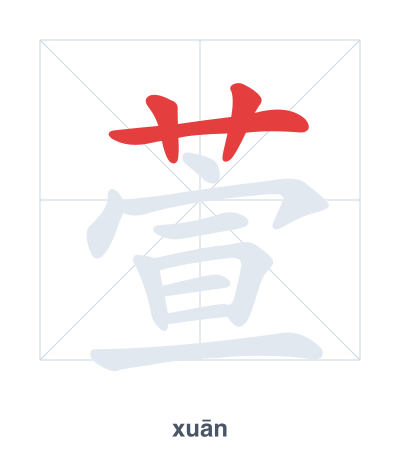
Open Hanzi Writer to see the animated stroke order and practice writing 萱 with real-time feedback.
The character 萱 (xuān) is written with 12 strokes. Follow the standard Chinese stroke order: top to bottom, left to right, outside before inside. The radical 艹 is one of its key components.
Practice the correct stroke order with the Hanzi Writer app to see animated stroke-by-stroke guidance with real-time feedback.
萱 means daylily.
The character 萱 is a phono-semantic compound: the radical 艹 (grass) indicates it is a plant, while 宣 (xuān) provides the pronunciation. In ancient Chinese tradition, the daylily was believed to dispel sorrow and was often planted in courtyards, linking the 'declaring' component to its joyful attribute.
💡 Memory Tip: Imagine a cheerful daylily (艹) raising a little speaker to 'declare' (宣) its bright orange petals to the whole garden.
院子里开了萱草。
yuàn zi lǐ kāi le xuān cǎo
Daylilies are blooming in the yard.
萱堂是指母亲。
xuān táng shì zhǐ mǔ qīn
'Xuantang' refers to one's mother.
萱苏是一种植物。
xuān sū shì yī zhǒng zhí wù
Xuansu is a type of plant.
Open Hanzi Writer to see the animated stroke order and practice writing 萱 with real-time feedback.
✨ Animated stroke order · Handwriting recognition · HSK-graded practice · Free to use
The character 萱 is composed of the radical 艹 (grass) on top and the phonetic component 宣 (xuān) below. The radical indicates that 萱 refers to a type of plant, specifically the daylily. The lower part gives the pronunciation and does not directly relate to the meaning.