胥 (xū) means "All; petty official" in Chinese. It has 9 strokes with the radical 月.
Rated 4/5 in difficulty (challenging).
Appears in 3+ common words including 胥吏 (xū lì), 伍子胥 (wǔ zi xū), 胥余 (xū yú).
Due to its 9 strokes, Hanzi Writer's error detection shows 胥 requires focused practice — most learners need 10+ attempts for consistent accuracy.
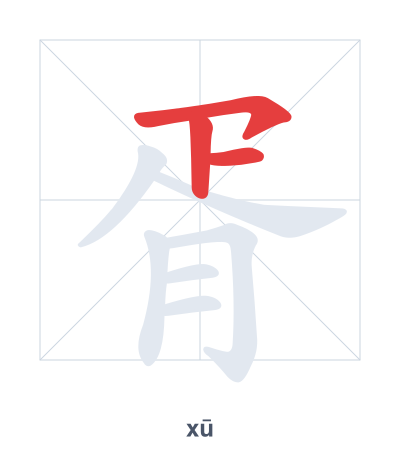
Open Hanzi Writer to see the animated stroke order and practice writing 胥 with real-time feedback.
The character 胥 (xū) is written with 9 strokes. Follow the standard Chinese stroke order: top to bottom, left to right, outside before inside. The radical 月 is one of its key components.
Practice the correct stroke order with the Hanzi Writer app to see animated stroke-by-stroke guidance with real-time feedback.
胥 means All; petty official.
胥 combines the radical 月 (meat/flesh) with 疋 (foot), originally depicting the flesh on a foot. This shape was later borrowed phonetically to mean "all" and also came to denote a petty official, possibly from the idea of a functionary who oversees or checks everything.
💡 Memory Tip: Picture a petty official (胥) stepping on a slab of meat (月) with his foot (疋) to claim all the meat for himself.
古代有很多胥吏。
gǔ dài yǒu hěn duō xū lì
There were many minor officials in ancient times.
伍子胥是历史人物。
wǔ zi xū shì lì shǐ rén wù
Wu Zixu is a historical figure.
这里的胥余很出名。
zhè lǐ de xū yú hěn chū míng
The coconuts here are very famous.
Open Hanzi Writer to see the animated stroke order and practice writing 胥 with real-time feedback.
✨ Animated stroke order · Handwriting recognition · HSK-graded practice · Free to use
胥 is composed of 疋 (pǐ) on top and 月 (yuè, the radical for flesh/moon) on the bottom. The top part 疋 originally depicted a foot or cloth, and the bottom 月 suggests the body, together forming a character that historically referred to a low-ranking clerk who handles documents or runs errands. This structure reflects the idea of a person (body) performing routine duties (footwork).