饷 (xiǎng) means "soldier's pay; provisions" in Chinese. It has 9 strokes with the radical 饣.
Rated 4/5 in difficulty (challenging).
Appears in 3+ common words including 饷银 (xiǎng yín), 关饷 (guān xiǎng), 军饷 (jūn xiǎng).
Due to its 9 strokes, Hanzi Writer's error detection shows 饷 requires focused practice — most learners need 10+ attempts for consistent accuracy.
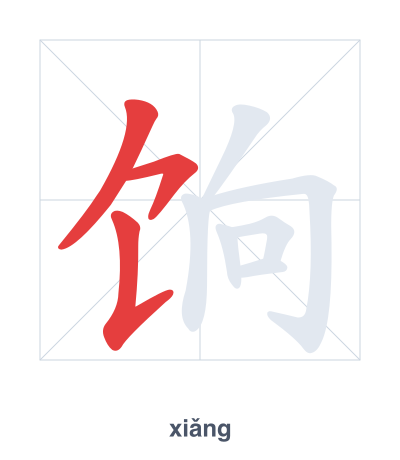
Open Hanzi Writer to see the animated stroke order and practice writing 饷 with real-time feedback.
The character 饷 (xiǎng) is written with 9 strokes. Follow the standard Chinese stroke order: top to bottom, left to right, outside before inside. The radical 饣 is one of its key components.
Practice the correct stroke order with the Hanzi Writer app to see animated stroke-by-stroke guidance with real-time feedback.
饷 means soldier's pay; provisions.
饷 combines the food radical 饣 (simplified from 食) with 向, which provides both the sound and the sense of 'toward'—thus food directed toward soldiers, meaning provisions or pay.
💡 Memory Tip: Picture a soldier holding a crate of food (饣) and looking toward a window (向) where his pay is handed out.
士兵们领到了饷银。
shì bīng men lǐng dào le xiǎng yín
The soldiers received their pay.
今天是关饷的日子。
jīn tiān shì guān xiǎng de rì zi
Today is payday.
军饷已经发下去了。
jūn xiǎng yǐ jīng fā xià qù le
The military pay has already been distributed.
Open Hanzi Writer to see the animated stroke order and practice writing 饷 with real-time feedback.
✨ Animated stroke order · Handwriting recognition · HSK-graded practice · Free to use
The character 饷 consists of the radical 饣 (food/eat) on the left, and the phonetic component 向 on the right. The left radical 饣 hints that the meaning is related to food or provisions, while 向 provides the pronunciation xiǎng. Together, they convey the concept of 'soldier's pay' which historically was often given in the form of grain or silver.