涎 (xián) means "saliva; spittle" in Chinese. It has 9 strokes with the radical 氵.
Rated 4/5 in difficulty (challenging).
Appears in 3+ common words including 垂涎 (chuí xián), 涎水 (xián shuǐ), 涎皮 (xián pí).
Due to its 9 strokes, Hanzi Writer's error detection shows 涎 requires focused practice — most learners need 10+ attempts for consistent accuracy.
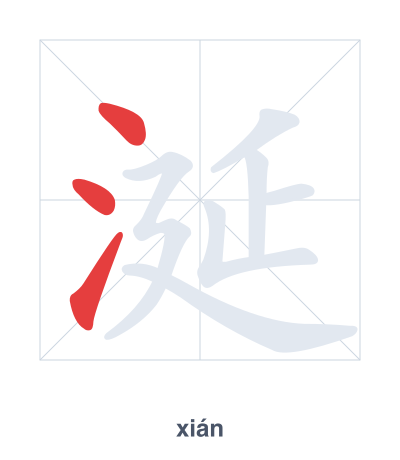
Open Hanzi Writer to see the animated stroke order and practice writing 涎 with real-time feedback.
The character 涎 (xián) is written with 9 strokes. Follow the standard Chinese stroke order: top to bottom, left to right, outside before inside. The radical 氵 is one of its key components.
Practice the correct stroke order with the Hanzi Writer app to see animated stroke-by-stroke guidance with real-time feedback.
涎 means saliva; spittle.
涎 is a phono-semantic compound. The left side 氵 (water) indicates fluid, while the right side 延 (yán, meaning extend) gives a hint to the sound and suggests saliva flowing or extending out. Together, it visually represents saliva as extending water from the mouth.
💡 Memory Tip: Picture a long stream of saliva (氵) stretching out from your mouth like a slimy extension (延).
他对美食垂涎三尺。
tā duì měi shí chuí xián sān chǐ
His mouth watered at the delicious food.
小孩流了很多涎水。
xiǎo hái liú le hěn duō xián shuǐ
The child is drooling a lot.
他总是涎皮赖脸的。
tā zǒng shì xián pí lài liǎn de
He is always being thick-skinned and shameless.
Open Hanzi Writer to see the animated stroke order and practice writing 涎 with real-time feedback.
✨ Animated stroke order · Handwriting recognition · HSK-graded practice · Free to use
涎 has the water radical 氵 on the left, which hints at the liquid nature of saliva. The right part 㕣 originally depicted a mouth with saliva flowing out, so together the character means saliva or spittle.