跹 (xiān) means "To dance; to wander." in Chinese. It has 13 strokes with the radical 足.
Rated 4.2/5 in difficulty (advanced).
Appears in 3+ common words including 翩跹 (piān xiān), 跹跹 (xiān xiān), 舞态翩跹 (wǔ tài piān xiān).
Due to its 13 strokes, Hanzi Writer's error detection shows 跹 requires focused practice — most learners need 10+ attempts for consistent accuracy.
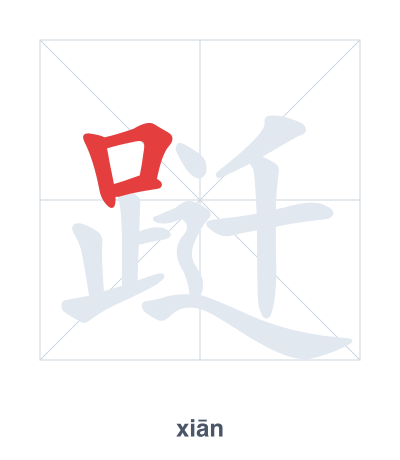
Open Hanzi Writer to see the animated stroke order and practice writing 跹 with real-time feedback.
The character 跹 (xiān) is written with 13 strokes. Follow the standard Chinese stroke order: top to bottom, left to right, outside before inside. The radical 足 is one of its key components.
Practice the correct stroke order with the Hanzi Writer app to see animated stroke-by-stroke guidance with real-time feedback.
跹 means To dance; to wander..
跹 is a phono-semantic compound: the left radical 足 (foot) indicates the action involves feet, while the right component 迁 (to move) hints at the wandering or shifting steps of a dance. In ancient texts, it often describes the swirling, graceful motion of dancers, as in the compound 蹁跹 (pián xiān).
💡 Memory Tip: Imagine feet (足) moving (迁) in a twirling dance, each step a playful wander across the floor.
蝴蝶在花丛中翩跹。
hú dié zài huā cóng zhōng piān xiān
The butterfly is fluttering among the flowers.
她的舞姿很跹跹。
tā de wǔ zī hěn xiān xiān
Her dancing is very light and graceful.
她的舞态十分翩跹。
tā de wǔ tài shí fēn piān xiān
Her dance movements are very light and graceful.
Open Hanzi Writer to see the animated stroke order and practice writing 跹 with real-time feedback.
✨ Animated stroke order · Handwriting recognition · HSK-graded practice · Free to use
跹 is formed by the radical 足 (foot) on the left and the component 迁 (move, change) on the right. Because dancing involves foot movement, the combination of "foot" and "move" suggests the idea of dancing or wandering.