Hanzi Writer

How to Write 葸 (xǐ) — Meaning “timid / afraid”

12 strokes Radical: 艹

葸 (xǐ) means "timid / afraid" in Chinese. It has 12 strokes with the radical 艹.

Rated 4.2/5 in difficulty (advanced).

Appears in 3+ common words including 畏葸 (wèi xǐ), 畏葸不前 (wèi xǐ bù qián), 葸然 (xǐ rán).

Due to its 12 strokes, Hanzi Writer's error detection shows 葸 requires focused practice — most learners need 10+ attempts for consistent accuracy.
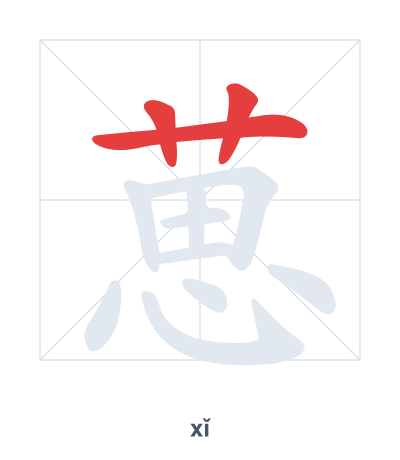
Stroke order practice for 葸 - xǐ

Practice Writing 葸 (xǐ)

Open Hanzi Writer to see the animated stroke order and practice writing 葸 with real-time feedback.

The character (xǐ) is written with 12 strokes. Follow the standard Chinese stroke order: top to bottom, left to right, outside before inside. The radical is one of its key components.

Practice the correct stroke order with the Hanzi Writer app to see animated stroke-by-stroke guidance with real-time feedback.

means timid / afraid.

Character
Pinyinxǐ (xi)
Meaningtimid / afraid
Strokes12
Radical
Difficulty4.2/5

葸 combines the grass radical (艹) with 思 (thought), suggesting thoughts hiding under grass—a visual metaphor for being too afraid to speak up or act, hence timid.

💡 Memory Tip: Picture a timid person hiding under a patch of grass (艹) while their thoughts (思) tremble with fear.

wèi xǐ
Timid / Fearful
wèi xǐ bù qián
To hesitate to move forward out of fear
xǐ rán
timidly

他表现得很畏葸。

tā biǎo xiàn dé hěn wèi xǐ

He acted very timidly.

面对困难别畏葸不前。

miàn duì kùn nán bié wèi xǐ bù qián

Don't shrink back from difficulties.

他神色葸然。

tā shén sè xǐ rán

He looked timid and fearful.

Character Pinyin Strokes Radical
(current) 12
10
10
10
Stroke order practice for 葸 - xǐ

Practice Writing 葸 (xǐ)

Open Hanzi Writer to see the animated stroke order and practice writing 葸 with real-time feedback.

✨ Animated stroke order · Handwriting recognition · HSK-graded practice · Free to use

Frequently Asked Questions about 葸

葸 is composed of the grass radical 艹 on top and 思 (sī, to think) below. The grass radical does not directly relate to fear; instead, 思 provides the sound (xǐ in ancient pronunciation) while the whole character borrows that sound to mean "timid." So the structure is phonetic-semantic, not pictographic.

Characters with Radical 艹

Other 12-Stroke Characters