徙 (xǐ) means "To move; to migrate." in Chinese. It has 11 strokes with the radical 彳.
Rated 4.2/5 in difficulty (advanced).
Appears in 3+ common words including 迁徙 (qiān xǐ), 徙居 (xǐ jū), 迁徙路径 (qiān xǐ lù jìng).
Due to its 11 strokes, Hanzi Writer's error detection shows 徙 requires focused practice — most learners need 10+ attempts for consistent accuracy.
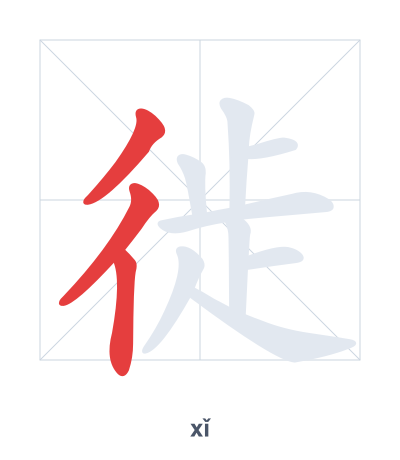
Open Hanzi Writer to see the animated stroke order and practice writing 徙 with real-time feedback.
The character 徙 (xǐ) is written with 11 strokes. Follow the standard Chinese stroke order: top to bottom, left to right, outside before inside. The radical 彳 is one of its key components.
Practice the correct stroke order with the Hanzi Writer app to see animated stroke-by-stroke guidance with real-time feedback.
徙 means To move; to migrate..
This character combines 彳 (step, implying movement) with 止 (foot) and 禾 (grain). The image is of a foot stepping away from grain, suggesting a migration or relocation, perhaps moving one's harvest to a new place.
💡 Memory Tip: Picture a person stepping (彳) over a pile of grain (禾) with a foot (止) as they move to a new home.
大雁往南迁徙。
dà yàn wǎng nán qiān xǐ
Wild geese migrate south.
他全家徙居海外。
tā quán jiā xǐ jū hǎi wài
His whole family moved abroad.
这是迁徙路径。
zhè shì qiān xǐ lù jìng
This is a migration path.
Open Hanzi Writer to see the animated stroke order and practice writing 徙 with real-time feedback.
✨ Animated stroke order · Handwriting recognition · HSK-graded practice · Free to use
徙 consists of the radical 彳 (meaning walking or step) on the left, and the component 步 (meaning step) on the right. Together they suggest 'moving step by step,' which leads to the meaning of migrating or changing location.