Hanzi Writer

How to Write 唏 (xī) — Meaning “Sound of sighing or sobbing.”

10 strokes Radical: 口

唏 (xī) means "Sound of sighing or sobbing." in Chinese. It has 10 strokes with the radical 口.

Rated 4.2/5 in difficulty (advanced).

Appears in 2+ common words including 唏嘘 (xī xū), 唏哩 (xī lī).

Due to its 10 strokes, Hanzi Writer's error detection shows 唏 requires focused practice — most learners need 10+ attempts for consistent accuracy.
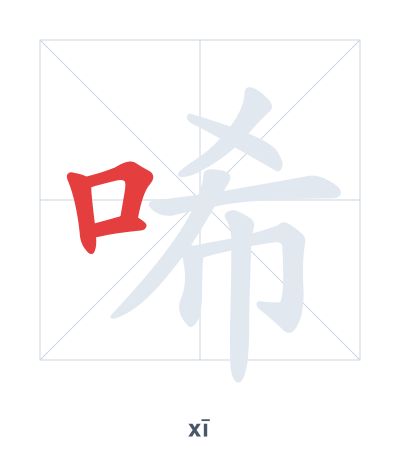
Stroke order practice for 唏 - xī

Practice Writing 唏 (xī)

Open Hanzi Writer to see the animated stroke order and practice writing 唏 with real-time feedback.

The character (xī) is written with 10 strokes. Follow the standard Chinese stroke order: top to bottom, left to right, outside before inside. The radical is one of its key components.

Practice the correct stroke order with the Hanzi Writer app to see animated stroke-by-stroke guidance with real-time feedback.

means Sound of sighing or sobbing..

Character
Pinyinxī (xi)
MeaningSound of sighing or sobbing.
Strokes10
Radical
Difficulty4.2/5

唏 combines the mouth radical 口 (indicating sound or speech) with 希, which serves as a phonetic component and also hints at 'hope'—the character depicts the sound of sighing or sobbing, as if a mouth letting out a breath of longing or sorrow.

💡 Memory Tip: Picture a mouth (口) that opens to sigh 'xi...' because the 'clothes' (the top of 希 like 爻) are too tight and the 'rag' (巾 below) is soaked with tears.

xī xū
To sigh or sob.
xī lī
Sound of rustling or rain.

大家都感到唏嘘。

dà jiā dōu gǎn dào xī xū

Everyone sighed with emotion.

雨唏哩地下着。

yǔ xī lī dì xià zhe

The rain is pattering down.

Character Pinyin Strokes Radical
(current) 10
ne / ní 8
ḿ 8
líng / lìng 8
Stroke order practice for 唏 - xī

Practice Writing 唏 (xī)

Open Hanzi Writer to see the animated stroke order and practice writing 唏 with real-time feedback.

✨ Animated stroke order · Handwriting recognition · HSK-graded practice · Free to use

Frequently Asked Questions about 唏

The character 唏 has the radical 口 (mouth) on the left, which indicates sound or speech. The right part is 希 (xī, meaning 'rare' or 'to hope'), but here it likely contributes to the pronunciation rather than meaning. Together, the mouth radical and the phonetic component create a character that represents a sound made by the mouth — specifically a sigh or sob.

Characters with Radical 口

Other 10-Stroke Characters