摀 (wǔ) means "cover (with hands)" in Chinese. It has 13 strokes with the radical 扌.
Rated 4.2/5 in difficulty (advanced).
Appears in 3+ common words including 摀住 (wǔ zhù), 摀脸 (wǔ liǎn), 摀嘴 (wǔ zuǐ).
Due to its 13 strokes, Hanzi Writer's error detection shows 摀 requires focused practice — most learners need 10+ attempts for consistent accuracy.
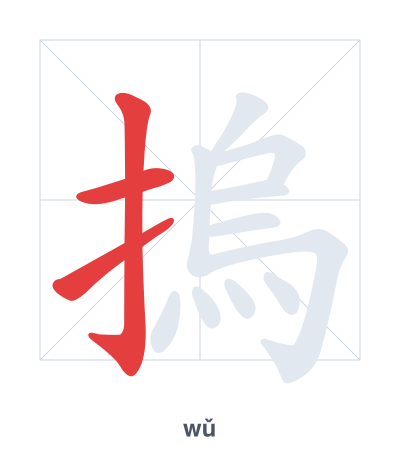
Open Hanzi Writer to see the animated stroke order and practice writing 摀 with real-time feedback.
The character 摀 (wǔ) is written with 13 strokes. Follow the standard Chinese stroke order: top to bottom, left to right, outside before inside. The radical 扌 is one of its key components.
Practice the correct stroke order with the Hanzi Writer app to see animated stroke-by-stroke guidance with real-time feedback.
摀 means cover (with hands).
摀 combines the hand radical 扌 with 屋 (wū, 'house/roof'), suggesting the action of using a hand to cover something as if putting a roof over it. The hand covers an area like a small shelter.
💡 Memory Tip: Imagine your hand (扌) turning into a tiny roof (屋) to cover a secret.
摀住你的耳朵。
wǔ zhù nǐ de ěr duǒ
Cover your ears.
她害羞地摀脸。
tā hài xiū dì wǔ liǎn
She covered her face shyly.
别摀着嘴说话。
bié wǔ zhe zuǐ shuō huà
Don't speak with your hand over your mouth.
Open Hanzi Writer to see the animated stroke order and practice writing 摀 with real-time feedback.
✨ Animated stroke order · Handwriting recognition · HSK-graded practice · Free to use
摀 combines the radical 扌 (hand) on the left with the phonetic component 屋 (wū, meaning house) on the right. The hand radical indicates the action involves the hand, while 屋 hints at the pronunciation wǔ. Together, they suggest using a hand to cover something, like shielding or hiding.