蜈 (wú) means "Centipede" in Chinese. It has 13 strokes with the radical 虫.
Rated 4.2/5 in difficulty (advanced).
Appears in 3+ common words including 蜈蚣 (wú gōng), 大蜈蚣 (dà wú gōng), 蜈蚣药 (wú gōng yào).
Due to its 13 strokes, Hanzi Writer's error detection shows 蜈 requires focused practice — most learners need 10+ attempts for consistent accuracy.
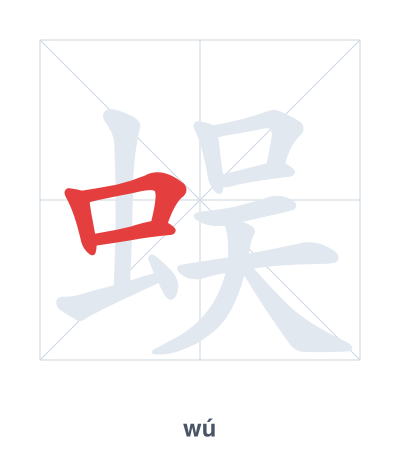
Open Hanzi Writer to see the animated stroke order and practice writing 蜈 with real-time feedback.
The character 蜈 (wú) is written with 13 strokes. Follow the standard Chinese stroke order: top to bottom, left to right, outside before inside. The radical 虫 is one of its key components.
Practice the correct stroke order with the Hanzi Writer app to see animated stroke-by-stroke guidance with real-time feedback.
蜈 means Centipede.
蜈 is a phono-semantic compound: the radical 虫 (insect) indicates it's a creature, while 吴 (wú) provides the pronunciation. The character specifically refers to the centipede, a long, many-legged arthropod.
💡 Memory Tip: Picture a centipede (虫) wearing a tiny crown like the ancient Wu (吴) king, scurrying sideways with all its legs.
蜈蚣有很多条腿。
wú gōng yǒu hěn duō tiáo tuǐ
Centipedes have many legs.
这里有一只大蜈蚣。
zhè lǐ yǒu yī zhī dà wú gōng
There is a large centipede here.
蜈蚣可以用来做药。
wú gōng kě yǐ yòng lái zuò yào
Centipedes can be used for medicine.
Open Hanzi Writer to see the animated stroke order and practice writing 蜈 with real-time feedback.
✨ Animated stroke order · Handwriting recognition · HSK-graded practice · Free to use
蜈 is composed of the radical 虫 (insect/worm) on the left and the phonetic component 吴 (wú) on the right. The 虫 radical indicates that the character relates to a creature, and 吴 provides the pronunciation wú, making 蜈 a phono-semantic compound meaning "centipede."