蚣 (gōng) means "centipede" in Chinese. It has 10 strokes with the radical 虫.
Rated 4.2/5 in difficulty (advanced).
Appears in 3+ common words including 蜈蚣 (wú gōng), 大蜈蚣 (dà wú gōng), 蜈蚣药 (wú gōng yào).
Due to its 10 strokes, Hanzi Writer's error detection shows 蚣 requires focused practice — most learners need 10+ attempts for consistent accuracy.
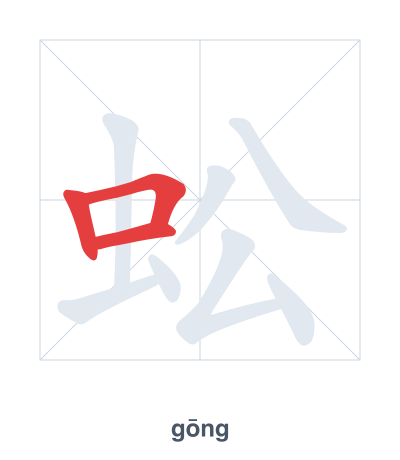
Open Hanzi Writer to see the animated stroke order and practice writing 蚣 with real-time feedback.
The character 蚣 (gōng) is written with 10 strokes. Follow the standard Chinese stroke order: top to bottom, left to right, outside before inside. The radical 虫 is one of its key components.
Practice the correct stroke order with the Hanzi Writer app to see animated stroke-by-stroke guidance with real-time feedback.
蚣 means centipede.
蚣 is a phono-semantic compound where 虫 (insect) hints at the creature's nature, and 公 (gōng) provides the pronunciation. Although 蚣 alone refers to a centipede, it is most commonly found in the compound 蜈蚣 (wúgōng, centipede).
💡 Memory Tip: Picture a centipede (虫) with a big head shaped like the character 公—it's a public menace crawling everywhere.
墙上有一只蜈蚣。
qiáng shàng yǒu yī zhī wú gōng
There is a centipede on the wall.
这只大蜈蚣很可怕。
zhè zhǐ dà wú gōng hěn kě pà
This big centipede is scary.
这是治蜈蚣咬的药。
zhè shì zhì wú gōng yǎo de yào
This is medicine for centipede bites.
Open Hanzi Writer to see the animated stroke order and practice writing 蚣 with real-time feedback.
✨ Animated stroke order · Handwriting recognition · HSK-graded practice · Free to use
The character 蚣 combines the radical 虫 (insect) on the left with the phonetic component 公 (gōng) on the right. The radical shows it is a type of insect, while 公 provides the pronunciation. Together they form the character meaning "centipede."