桐 (tóng) means "Tong tree / Paulownia" in Chinese. It has 10 strokes with the radical 木.
Rated 4.2/5 in difficulty (advanced).
Appears in 3+ common words including 梧桐 (wú tóng), 油桐 (yóu tóng), 泡桐 (pāo tóng).
Due to its 10 strokes, Hanzi Writer's error detection shows 桐 requires focused practice — most learners need 10+ attempts for consistent accuracy.
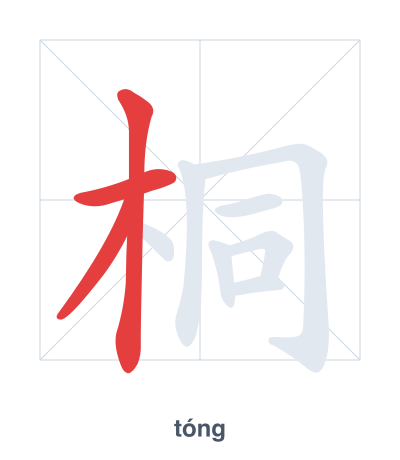
Open Hanzi Writer to see the animated stroke order and practice writing 桐 with real-time feedback.
The character 桐 (tóng) is written with 10 strokes. Follow the standard Chinese stroke order: top to bottom, left to right, outside before inside. The radical 木 is one of its key components.
Practice the correct stroke order with the Hanzi Writer app to see animated stroke-by-stroke guidance with real-time feedback.
桐 means Tong tree / Paulownia.
桐 is a phono-semantic compound where 木 (tree) indicates it's a type of tree, and 同 (tóng, meaning 'same' or 'together') provides the pronunciation. The paulownia tree is known for its lightweight, uniform wood, which made it ideal for crafting musical instruments like the zither in ancient China.
💡 Memory Tip: Picture the paulownia tree (木) with an old man playing a zither that sounds the same (同) every time he plucks the strings.
梧桐树的叶子很大。
wú tóng shù de yè zi hěn dà
The leaves of the parasol tree are very large.
油桐可以用来榨油。
yóu tóng kě yǐ yòng lái zhà yóu
Tung trees can be used to extract oil.
泡桐花开得很漂亮。
pāo tóng huā kāi dé hěn piào liàng
The Paulownia flowers are blooming beautifully.
Open Hanzi Writer to see the animated stroke order and practice writing 桐 with real-time feedback.
✨ Animated stroke order · Handwriting recognition · HSK-graded practice · Free to use
桐 is made of the radical 木 (wood/tree) on the left, and 同 (tóng, meaning 'same') on the right as a phonetic component. The radical tells you it is a type of tree, while 同 hints at the pronunciation 'tóng'.