幄 (wò) means "Tent / Canopy" in Chinese. It has 12 strokes with the radical 巾.
Rated 4.2/5 in difficulty (advanced).
Appears in 3+ common words including 帷幄 (wéi wò), 帐幄 (zhàng wò), 幄幕 (wò mù).
Due to its 12 strokes, Hanzi Writer's error detection shows 幄 requires focused practice — most learners need 10+ attempts for consistent accuracy.
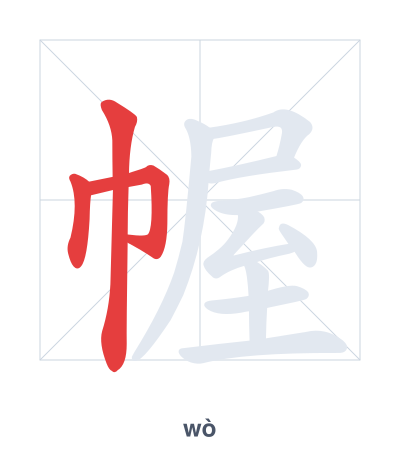
Open Hanzi Writer to see the animated stroke order and practice writing 幄 with real-time feedback.
The character 幄 (wò) is written with 12 strokes. Follow the standard Chinese stroke order: top to bottom, left to right, outside before inside. The radical 巾 is one of its key components.
Practice the correct stroke order with the Hanzi Writer app to see animated stroke-by-stroke guidance with real-time feedback.
幄 means Tent / Canopy.
This character is a semantic-phonetic compound combining the radical 巾 (cloth) with 屋 (wū, meaning house/room and also providing pronunciation). The cloth radical indicates the material of the tent or canopy, while 屋 suggests a covered, room-like space. Together, they represent a fabric enclosure or tent.
💡 Memory Tip: Picture a cloth (巾) draped over a miniature house (屋) to form a tent-like canopy.
运筹帷幄之中。
yùn chóu wéi wò zhī zhōng
To devise strategies within a command tent.
士兵住在帐幄里。
shì bīng zhù zài zhàng wò lǐ
The soldier lived in a tent.
幄幕遮住了光。
wò mù zhē zhù le guāng
The curtain blocked the light.
Open Hanzi Writer to see the animated stroke order and practice writing 幄 with real-time feedback.
✨ Animated stroke order · Handwriting recognition · HSK-graded practice · Free to use
The left side is the radical 巾 (jīn), meaning 'cloth', and the right side is 屋 (wū), meaning 'house' or 'room'. Together, they suggest a cloth structure like a house, which is a tent or canopy.