塕 (wěng) means "rising dust" in Chinese. It has 13 strokes with the radical 土.
Rated 4.2/5 in difficulty (advanced).
Appears in 3+ common words including 塕埃 (wěng āi), 塕塕 (wěng wěng), 尘塕 (chén wěng).
Due to its 13 strokes, Hanzi Writer's error detection shows 塕 requires focused practice — most learners need 10+ attempts for consistent accuracy.
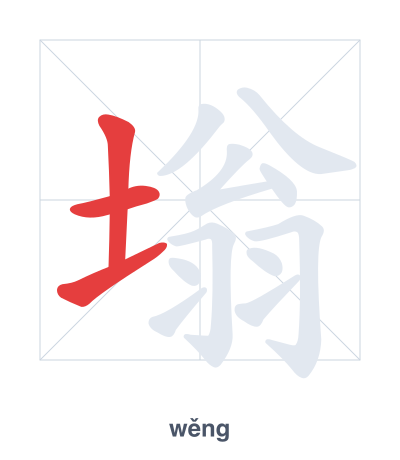
Open Hanzi Writer to see the animated stroke order and practice writing 塕 with real-time feedback.
The character 塕 (wěng) is written with 13 strokes. Follow the standard Chinese stroke order: top to bottom, left to right, outside before inside. The radical 土 is one of its key components.
Practice the correct stroke order with the Hanzi Writer app to see animated stroke-by-stroke guidance with real-time feedback.
塕 means rising dust.
A phono-semantic compound: 土 (earth, the radical) indicates dust rising from the ground, and 翁 (wěng) supplies the sound. The character's visual form combines 'earth' with the phonetic element 'old man' to represent the idea of powdered soil floating in the air.
💡 Memory Tip: Picture an old man (翁) shuffling his feet on the earth (土), kicking up a cloud of rising dust.
屋子里落满了塕埃。
wū zi lǐ luò mǎn le wěng āi
The room is covered in dust.
风吹得尘土塕塕的。
fēng chuī dé chén tǔ wěng wěng de
The wind blew the dust into thick clouds.
空气中有很多尘塕。
kōng qì zhōng yǒu hěn duō chén wěng
There is a lot of dust in the air.
Open Hanzi Writer to see the animated stroke order and practice writing 塕 with real-time feedback.
✨ Animated stroke order · Handwriting recognition · HSK-graded practice · Free to use
塕 has the radical 土 (earth, soil) on the left and 翁 (wěng, meaning old man) on the right as a phonetic component. Together, 土 suggests dust or earth, and 翁 provides the sound, combining to describe dust rising into the air.