逶 (wēi) means "winding" in Chinese. It has 11 strokes with the radical 辶.
Rated 4.2/5 in difficulty (advanced).
Appears in 3+ common words including 逶迤 (wēi yí), 逶随 (wēi suí), 逶迟 (wēi chí).
Due to its 11 strokes, Hanzi Writer's error detection shows 逶 requires focused practice — most learners need 10+ attempts for consistent accuracy.
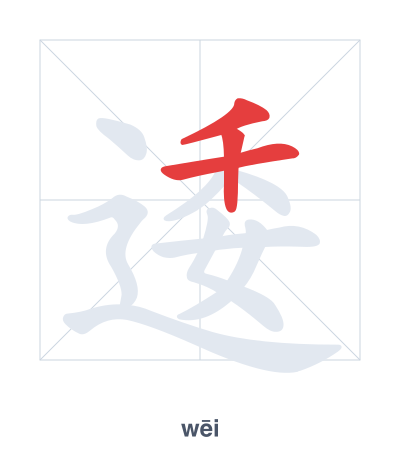
Open Hanzi Writer to see the animated stroke order and practice writing 逶 with real-time feedback.
The character 逶 (wēi) is written with 11 strokes. Follow the standard Chinese stroke order: top to bottom, left to right, outside before inside. The radical 辶 is one of its key components.
Practice the correct stroke order with the Hanzi Writer app to see animated stroke-by-stroke guidance with real-time feedback.
逶 means winding.
This character combines the radical 辶 (walking path) with 委 (wěi), which provides a phonetic clue. The meaning 'winding' evokes a path that meanders, like a river or road curving back and forth.
💡 Memory Tip: Imagine a woman (女) carrying a heavy bundle of grain (禾) on her head, forced to walk in a long, swaying zigzag along the winding path (辶).
长城逶迤在山间。
cháng chéng wēi yí zài shān jiān
The Great Wall meanders through the mountains.
影子逶随在身后。
yǐng zi wēi suí zài shēn hòu
The shadow follows closely behind.
路途遥远且逶迟。
lù tú yáo yuǎn qiě wēi chí
The journey is long and winding.
Open Hanzi Writer to see the animated stroke order and practice writing 逶 with real-time feedback.
✨ Animated stroke order · Handwriting recognition · HSK-graded practice · Free to use
逶 is made of the radical 辶 (walk) on the left and the component 委 (wěi, to entrust) on the right. The 辶 gives the idea of movement or a path, while 委 contributes both sound and a sense of crookedness, so together they create the meaning of a winding path.