枉 (wǎng) means "in vain; to twist; wrong" in Chinese. It has 8 strokes with the radical 木, and is HSK Level 7.
Rated 3.7/5 in difficulty (challenging).
Harder than 27% of HSK Level 7 characters.
Appears in 3+ common words including 冤枉 (yuān wǎng), 枉费 (wǎng fèi), 枉然 (wǎng rán).
Due to its 8 strokes, Hanzi Writer's error detection shows 枉 requires focused practice — most learners need 10+ attempts for consistent accuracy.
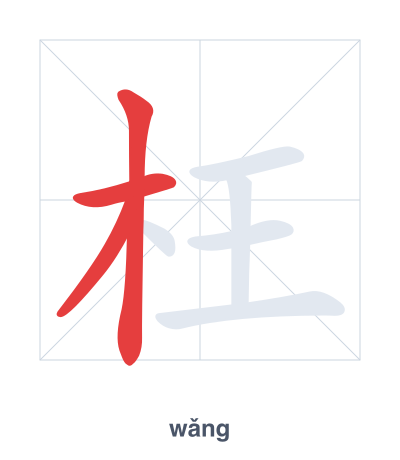
Open Hanzi Writer to see the animated stroke order and practice writing 枉 with real-time feedback.
The character 枉 (wǎng) is written with 8 strokes. Follow the standard Chinese stroke order: top to bottom, left to right, outside before inside. The radical 木 is one of its key components.
Practice the correct stroke order with the Hanzi Writer app to see animated stroke-by-stroke guidance with real-time feedback.
枉 means in vain; to twist; wrong.
As an HSK Level 7 character, 枉 is an intermediate-level character.
It is a compound of 木 (tree) and 王 (king), where 王 originally indicated the sound. The character once depicted a crooked or bent tree, which extended to mean 'to twist' or 'to act wrongly', and later 'in vain' as wasted effort trying to straighten something already distorted.
💡 Memory Tip: The king (王) tried to straighten a twisted tree (木) but failed—all his work was in vain.
你冤枉他了。
nǐ yuān wǎng tā le
You have wronged him.
别枉费时间。
bié wǎng fèi shí jiān
Don't waste your time.
努力全枉然。
nǔ lì quán wǎng rán
All efforts were in vain.
Open Hanzi Writer to see the animated stroke order and practice writing 枉 with real-time feedback.
✨ Animated stroke order · Handwriting recognition · HSK-graded practice · Free to use
枉 is a left-right structure. The left radical 木 (tree/wood) suggests a connection to wood or objects, while the right part 王 (king) provides the pronunciation clue wǎng. Together, the original meaning related to 'crooked wood' evolved into the abstract senses of 'to twist' or 'in vain'.