惘 (wǎng) means "Bewildered" in Chinese. It has 11 strokes with the radical 忄.
Rated 4.2/5 in difficulty (advanced).
Appears in 3+ common words including 迷惘 (mí wǎng), 怅惘 (chàng wǎng), 惘然 (wǎng rán).
Due to its 11 strokes, Hanzi Writer's error detection shows 惘 requires focused practice — most learners need 10+ attempts for consistent accuracy.
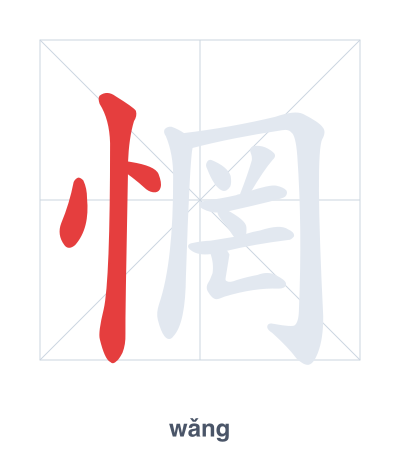
Open Hanzi Writer to see the animated stroke order and practice writing 惘 with real-time feedback.
The character 惘 (wǎng) is written with 11 strokes. Follow the standard Chinese stroke order: top to bottom, left to right, outside before inside. The radical 忄 is one of its key components.
Practice the correct stroke order with the Hanzi Writer app to see animated stroke-by-stroke guidance with real-time feedback.
惘 means Bewildered.
The character 惘 is a compound of the radical 忄 (heart/mind) and 罔 (wǎng, meaning 'net' or 'to deceive'). The right component 罔 depicts a net that traps or confuses, so together with the heart radical, it conveys the idea of the mind being caught in confusion — feeling bewildered or lost.
💡 Memory Tip: Picture your heart (忄) tangled in a net (罔), leaving you utterly bewildered about how to escape.
他的眼神很迷惘。
tā de yǎn shén hěn mí wǎng
His gaze is very perplexed.
他心里感到很怅惘。
tā xīn lǐ gǎn dào hěn chàng wǎng
He feels very listless and distracted.
他听后感到有些惘然。
tā tīng hòu gǎn dào yǒu xiē wǎng rán
He felt a bit lost after hearing it.
Open Hanzi Writer to see the animated stroke order and practice writing 惘 with real-time feedback.
✨ Animated stroke order · Handwriting recognition · HSK-graded practice · Free to use
The character 惘 combines the radical 忄 (heart) with 罔 (wǎng). The heart radical suggests feelings or emotions, while 罔 contributes the meaning of "net" or "deceive," together implying a heart confused or entangled as if caught in a net.