脘 (wǎn) means "stomach cavity; epigastrium" in Chinese. It has 11 strokes with the radical 月.
Rated 4.2/5 in difficulty (advanced).
Appears in 3+ common words including 胃脘 (wèi wǎn), 脘腹 (wǎn fù), 脘痛 (wǎn tòng).
Due to its 11 strokes, Hanzi Writer's error detection shows 脘 requires focused practice — most learners need 10+ attempts for consistent accuracy.
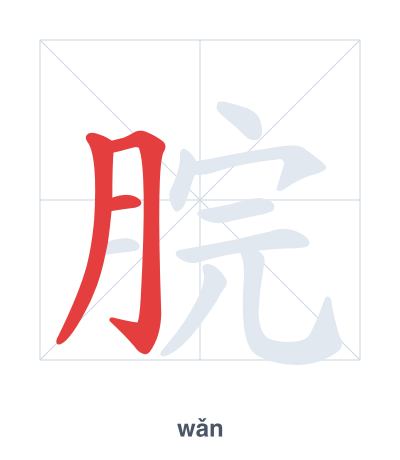
Open Hanzi Writer to see the animated stroke order and practice writing 脘 with real-time feedback.
The character 脘 (wǎn) is written with 11 strokes. Follow the standard Chinese stroke order: top to bottom, left to right, outside before inside. The radical 月 is one of its key components.
Practice the correct stroke order with the Hanzi Writer app to see animated stroke-by-stroke guidance with real-time feedback.
脘 means stomach cavity; epigastrium.
This compound character combines the meat radical 月 (flesh) with 完 (wán, 'complete' or 'whole'), suggesting the stomach cavity as a complete fleshy hollow within the body.
💡 Memory Tip: Picture a stomach (月) that is completely (完) stuffed like a full cavity after a big meal.
他感到胃脘不适。
tā gǎn dào wèi wǎn bù shì
He feels discomfort in his stomach.
脘腹胀痛很难受。
wǎn fù zhàng tòng hěn nán shòu
Abdominal bloating and pain are very uncomfortable.
这种药能治脘痛。
zhè zhǒng yào néng zhì wǎn tòng
This medicine can treat stomach aches.
Open Hanzi Writer to see the animated stroke order and practice writing 脘 with real-time feedback.
✨ Animated stroke order · Handwriting recognition · HSK-graded practice · Free to use
脘 is composed of the radical 月 (月字旁), which relates to flesh or body parts, and the component 完 (wán, meaning "complete"). The 月 radical tells you it is a part of the body, while 完 gives a clue to the pronunciation (wǎn). Together, they form a character that refers to the stomach cavity or epigastrium.