绔 (kù) means "Trousers (ancient)." in Chinese. It has 9 strokes with the radical 纟.
Rated 4/5 in difficulty (challenging).
Appears in 3+ common words including 纨绔 (wán kù), 绔褶 (kù zhě), 绔士 (kù shì).
Due to its 9 strokes, Hanzi Writer's error detection shows 绔 requires focused practice — most learners need 10+ attempts for consistent accuracy.
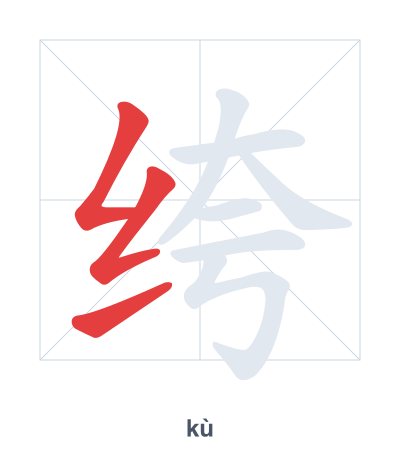
Open Hanzi Writer to see the animated stroke order and practice writing 绔 with real-time feedback.
The character 绔 (kù) is written with 9 strokes. Follow the standard Chinese stroke order: top to bottom, left to right, outside before inside. The radical 纟 is one of its key components.
Practice the correct stroke order with the Hanzi Writer app to see animated stroke-by-stroke guidance with real-time feedback.
绔 means Trousers (ancient)..
The character 绔 combines the silk radical 纟 (indicating clothing or fabric) with the phonetic component 夸 (kuā), which originally meant 'to stretch' or 'big,' reflecting the loose, open-crotch style of ancient Chinese trousers. These trousers were often made of silk for the wealthy, giving rise to the term 纨绔 (wánkù) for silk-trousered rich idlers.
💡 Memory Tip: Imagine a boastful person (夸) showing off their fancy trousers made of silk (纟), striding around with a proud stretch in their step.
他是个纨绔子弟。
tā shì gè wán kù zǐ dì
He is a playboy from a wealthy family.
这种绔褶很特别。
zhè zhǒng kù zhě hěn tè bié
This pair of pleated trousers is very special.
他看起来像个绔士。
tā kàn qǐ lái xiàng gè kù shì
He looks like a dandy.
Open Hanzi Writer to see the animated stroke order and practice writing 绔 with real-time feedback.
✨ Animated stroke order · Handwriting recognition · HSK-graded practice · Free to use
绔 is made of the radical 纟 (silk) on the left and 夸 (to boast) on the right. The silk radical suggests the character relates to clothing, specifically ancient trousers made of silk. The right component 夸 links to the idea of showing off, as silk trousers were a symbol of wealth.