讬 (tuō) means "To entrust or rely on" in Chinese. It has 5 strokes with the radical 讠.
Rated 2.7/5 in difficulty (moderate).
Appears in 3+ common words including 讬付 (tuō fù), 讬管 (tuō guǎn), 讬词 (tuō cí).
Hanzi Writer's stroke validation shows learners typically need 5-8 attempts to write 讬 with correct proportion and order.
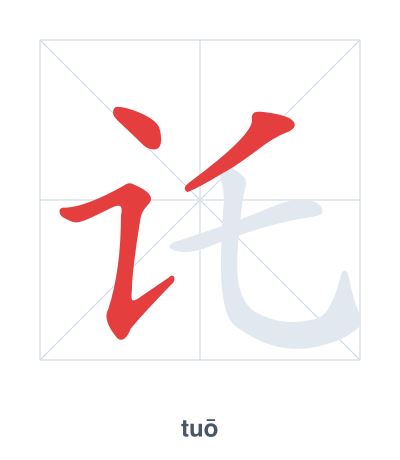
Open Hanzi Writer to see the animated stroke order and practice writing 讬 with real-time feedback.
The character 讬 (tuō) is written with 5 strokes. Follow the standard Chinese stroke order: top to bottom, left to right, outside before inside. The radical 讠 is one of its key components.
Practice the correct stroke order with the Hanzi Writer app to see animated stroke-by-stroke guidance with real-time feedback.
讬 means To entrust or rely on.
The character 讬 is the simplified form of 託, a phono-semantic compound. The left side 讠 (speech) indicates that the meaning relates to words or spoken promises, while the right side 乇 originally depicted a plant taking root, reinforcing the idea of 'relying on' or 'entrusting' as if anchoring trust in someone. Together, they suggest verbally committing something important to another's care.
💡 Memory Tip: Entrust your words (讠) to a T-shaped hook (乇) and rely on it to hold them safe.
他把孩子讬付给我。
tā bǎ hái zi tuō fù gěi wǒ
He entrusted the child to me.
孩子在讬管班。
hái zi zài tuō guǎn bān
The child is in an after-school care center.
这只是他的讬词。
zhè zhǐ shì tā de tuō cí
This is just his excuse.
Open Hanzi Writer to see the animated stroke order and practice writing 讬 with real-time feedback.
✨ Animated stroke order · Handwriting recognition · HSK-graded practice · Free to use
The character 讬 combines the speech radical 讠 on the left with the component 乇 on the right. The speech radical suggests that the action involves words or speaking, while 乇 provides the sound and adds the idea of entrusting or relying. Together, they create the meaning of verbally entrusting something to someone.