臀 (tún) means "buttocks; hips" in Chinese. It has 17 strokes with the radical 月.
Rated 4.2/5 in difficulty (advanced).
Appears in 3+ common words including 臀部 (tún bù), 臀围 (tún wéi), 翘臀 (qiào tún).
Due to its 17 strokes, Hanzi Writer's error detection shows 臀 requires focused practice — most learners need 10+ attempts for consistent accuracy.
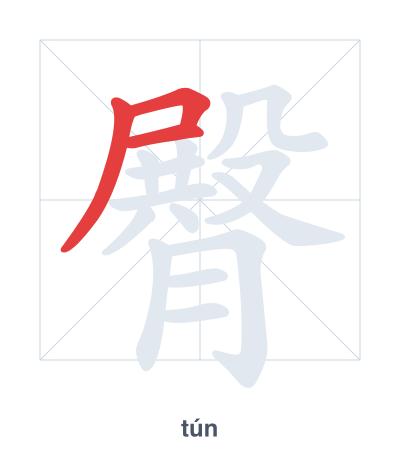
Open Hanzi Writer to see the animated stroke order and practice writing 臀 with real-time feedback.
The character 臀 (tún) is written with 17 strokes. Follow the standard Chinese stroke order: top to bottom, left to right, outside before inside. The radical 月 is one of its key components.
Practice the correct stroke order with the Hanzi Writer app to see animated stroke-by-stroke guidance with real-time feedback.
臀 means buttocks; hips.
The character 臀 combines the flesh radical 月 (indicating a body part) with 殿, which originally meant 'rear of a building' or 'rearguard', together signifying the rear part of the human body. This compound highlights both the physical flesh and the concept of being at the back.
💡 Memory Tip: Picture a flesh-toned palace (殿) where the grand throne is actually a giant butt—the rear of the building is the rear of the body.
跑步对臀部有好处。
pǎo bù duì tún bù yǒu hǎo chù
Running is good for your glutes.
这件裤子臀围太小。
zhè jiàn kù zi tún wéi tài xiǎo
The hip measurement of these pants is too small.
她通过健身练出了翘臀。
tā tōng guò jiàn shēn liàn chū le qiào tún
She got a perky butt through working out.
Open Hanzi Writer to see the animated stroke order and practice writing 臀 with real-time feedback.
✨ Animated stroke order · Handwriting recognition · HSK-graded practice · Free to use
臀 is made of two parts: the left radical 月 (flesh/body) and the right part 殿, which gives the sound tún. The 月 radical indicates that the character refers to a body part, specifically the buttocks. The right side 殿 originally meant 'palace' and acts as a phonetic component without contributing to meaning.