荼 (tú) means "Bitter herb or thistle" in Chinese. It has 10 strokes with the radical 艹.
Rated 4.2/5 in difficulty (advanced).
Appears in 3+ common words including 如火如荼 (rú huǒ rú tú), 荼蘼 (tú mí), 苦荼 (kǔ tú).
Due to its 10 strokes, Hanzi Writer's error detection shows 荼 requires focused practice — most learners need 10+ attempts for consistent accuracy.
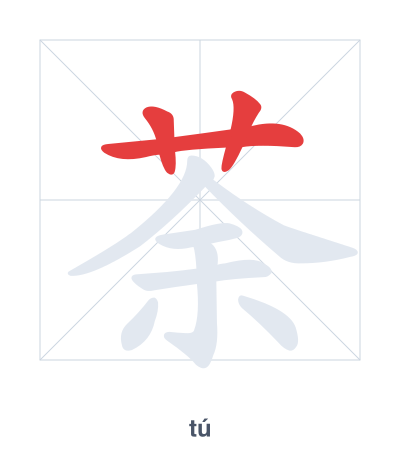
Open Hanzi Writer to see the animated stroke order and practice writing 荼 with real-time feedback.
The character 荼 (tú) is written with 10 strokes. Follow the standard Chinese stroke order: top to bottom, left to right, outside before inside. The radical 艹 is one of its key components.
Practice the correct stroke order with the Hanzi Writer app to see animated stroke-by-stroke guidance with real-time feedback.
荼 means Bitter herb or thistle.
This compound character combines the grass radical 艹 with 余 (yú) as a phonetic component, indicating a type of bitter herb or thistle. The character originally referred to a bitter plant and later evolved to mean tea (茶), with the extra stroke representing the plant's harsh taste.
💡 Memory Tip: Picture a bitter herb (艹) so nasty that it makes you go 'too-oo' (tú) and spit out the extra (余) leaves.
比赛进行得如火如荼。
bǐ sài jìn xíng dé rú huǒ rú tú
The competition is in full swing.
荼蘼花在春天开放。
tú mí huā zài chūn tiān kāi fàng
The blackberry rose blooms in spring.
这杯苦荼的味道很特别。
zhè bēi kǔ tú de wèi dào hěn tè bié
This cup of bitter tea has a very special taste.
Open Hanzi Writer to see the animated stroke order and practice writing 荼 with real-time feedback.
✨ Animated stroke order · Handwriting recognition · HSK-graded practice · Free to use
荼 is made of the grass radical (艹) on top and 余 (yú, meaning "surplus" or "remaining") below. The grass radical connects it to plants, and 余 hints at abundance or leftover growth, together suggesting a bitter herb that grows wildly or excessively.