恸 (tòng) means "Deep sorrow or grief." in Chinese. It has 9 strokes with the radical 忄.
Rated 4/5 in difficulty (challenging).
Appears in 3+ common words including 恸哭 (tòng kū), 哀恸 (āi tòng), 悲恸 (bēi tòng).
Due to its 9 strokes, Hanzi Writer's error detection shows 恸 requires focused practice — most learners need 10+ attempts for consistent accuracy.
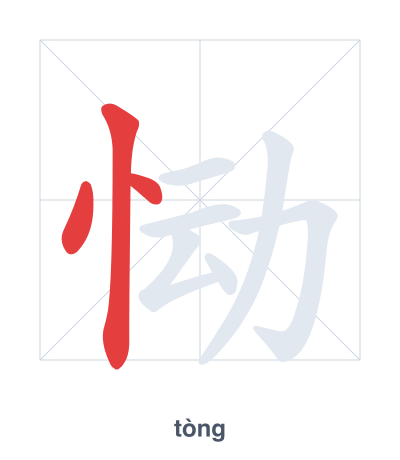
Open Hanzi Writer to see the animated stroke order and practice writing 恸 with real-time feedback.
The character 恸 (tòng) is written with 9 strokes. Follow the standard Chinese stroke order: top to bottom, left to right, outside before inside. The radical 忄 is one of its key components.
Practice the correct stroke order with the Hanzi Writer app to see animated stroke-by-stroke guidance with real-time feedback.
恸 means Deep sorrow or grief..
恸 is a compound character combining the heart radical 忄 (xīn) with 动 (dòng, 'move'). The heart 'moved' by intense emotion conveys the meaning of deep sorrow or grief, as if the heart is physically shaken by loss.
💡 Memory Tip: Imagine your heart (忄) is so heavy with grief that it can only move (动) in slow, painful thuds.
他在葬礼上恸哭。
tā zài zàng lǐ shàng tòng kū
He wailed bitterly at the funeral.
大家都感到哀恸。
dà jiā dōu gǎn dào āi tòng
Everyone felt deeply grieved.
他的心情很悲恸。
tā de xīn qíng hěn bēi tòng
He is in deep grief.
Open Hanzi Writer to see the animated stroke order and practice writing 恸 with real-time feedback.
✨ Animated stroke order · Handwriting recognition · HSK-graded practice · Free to use
恸 is composed of the heart radical 忄 on the left and the character 动 (meaning "move") on the right. This suggests a heart that is deeply moved or shaken, describing intense grief or sorrow.