廷 (tíng) means "Court / Palace courtyard" in Chinese. It has 6 strokes with the radical 廴, and is HSK Level 7.
Rated 2.9/5 in difficulty (moderate).
Harder than 6% of HSK Level 7 characters.
Appears in 3+ common words including 宫廷 (gōng tíng), 朝廷 (cháo tíng), 内廷 (nèi tíng).
Hanzi Writer's stroke validation shows learners typically need 5-8 attempts to write 廷 with correct proportion and order.
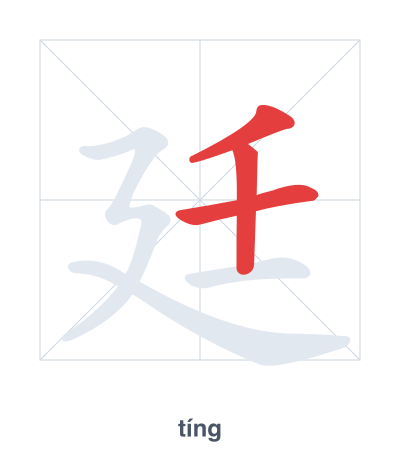
Open Hanzi Writer to see the animated stroke order and practice writing 廷 with real-time feedback.
The character 廷 (tíng) is written with 6 strokes. Follow the standard Chinese stroke order: top to bottom, left to right, outside before inside. The radical 廴 is one of its key components.
Practice the correct stroke order with the Hanzi Writer app to see animated stroke-by-stroke guidance with real-time feedback.
廷 means Court / Palace courtyard.
As an HSK Level 7 character, 廷 is an intermediate-level character.
The character 廷 combines the radical 廴 (a long stride or walkway) with 壬, which originally depicted a person standing. Together, they represent a person standing in a palace courtyard or court, the place where the ruler holds audience.
💡 Memory Tip: Imagine a long walkway (廴) leading to a courtyard where a noble person (壬) stands, representing the imperial court.
宫廷剧很受欢迎。
gōng tíng jù hěn shòu huān yíng
Palace dramas are very popular.
朝廷有很多官员。
cháo tíng yǒu hěn duō guān yuán
There are many officials in the imperial court.
内廷的生活很安静。
nèi tíng de shēng huó hěn ān jìng
Life in the inner court is very quiet.
Open Hanzi Writer to see the animated stroke order and practice writing 廷 with real-time feedback.
✨ Animated stroke order · Handwriting recognition · HSK-graded practice · Free to use
廷 consists of the radical 廴 (long stride) on the left and 壬 (a kneeling figure or a workman) on the right. The radical 廴 suggests movement or a path, while 壬 historically depicted a person standing, together conveying a person walking into a formal space like a court or courtyard.