眺 (tiào) means "to look into the distance" in Chinese. It has 11 strokes with the radical 目.
Rated 4.2/5 in difficulty (advanced).
Appears in 3+ common words including 远眺 (yuǎn tiào), 眺望 (tiào wàng), 登高远眺 (dēng gāo yuǎn tiào).
Due to its 11 strokes, Hanzi Writer's error detection shows 眺 requires focused practice — most learners need 10+ attempts for consistent accuracy.
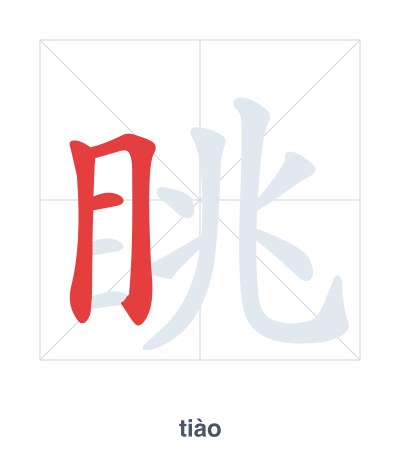
Open Hanzi Writer to see the animated stroke order and practice writing 眺 with real-time feedback.
The character 眺 (tiào) is written with 11 strokes. Follow the standard Chinese stroke order: top to bottom, left to right, outside before inside. The radical 目 is one of its key components.
Practice the correct stroke order with the Hanzi Writer app to see animated stroke-by-stroke guidance with real-time feedback.
眺 means to look into the distance.
眺 combines the radical 目 (eye) with 兆 (zhào, 'omen' or 'a million'), which acts as a phonetic hint and also suggests a vast number—using your eyes to scan a distant, expansive view. The character visually depicts an eye looking toward something far off, like searching for omens on the horizon.
💡 Memory Tip: Imagine your eye (目) peering so far that you see a million (兆) tiny details on the distant mountains.
他在山顶远眺大海。
tā zài shān dǐng yuǎn tiào dà hǎi
He is looking out at the sea from the mountaintop.
我们可以眺望远处的山。
wǒ men kě yǐ tiào wàng yuǎn chù de shān
We can look out at the distant mountains.
登高远眺风景很美。
dēng gāo yuǎn tiào fēng jǐng hěn měi
The scenery is beautiful when looking out from a high place.
Open Hanzi Writer to see the animated stroke order and practice writing 眺 with real-time feedback.
✨ Animated stroke order · Handwriting recognition · HSK-graded practice · Free to use
眺 is made of the radical 目 (eye) on the left and 兆 (tiào, meaning omen or sign) on the right. The eye radical directly points to the action of looking, while 兆 provides the sound and suggests something far away or distant. Together they mean 'to look into the distance'.