笤 (tiáo) means "broom" in Chinese. It has 11 strokes with the radical 竹.
Rated 4.2/5 in difficulty (advanced).
Appears in 3+ common words including 笤帚 (tiáo zhǒu), 小笤帚 (xiǎo tiáo zhǒu), 扫笤帚 (sǎo tiáo zhǒu).
Due to its 11 strokes, Hanzi Writer's error detection shows 笤 requires focused practice — most learners need 10+ attempts for consistent accuracy.
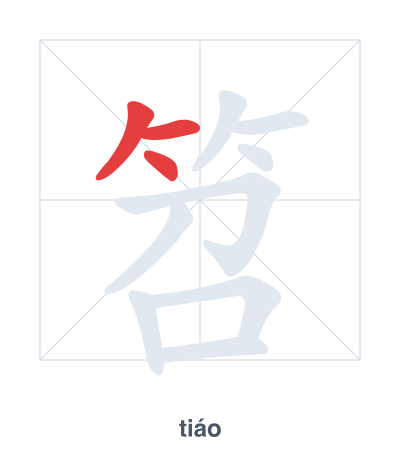
Open Hanzi Writer to see the animated stroke order and practice writing 笤 with real-time feedback.
The character 笤 (tiáo) is written with 11 strokes. Follow the standard Chinese stroke order: top to bottom, left to right, outside before inside. The radical 竹 is one of its key components.
Practice the correct stroke order with the Hanzi Writer app to see animated stroke-by-stroke guidance with real-time feedback.
笤 means broom.
笤 combines the radical 竹 (bamboo) with 召, which provides a phonetic hint (tiáo from zhào). Bamboo was commonly used to make brooms, so the character visually represents a broom made of bamboo stalks.
💡 Memory Tip: Picture a bamboo broom (竹) sweeping up a pile of trash, and the handle has a 'call' button (召) to summon you to clean.
请拿一下笤帚。
qǐng ná yī xià tiáo zhǒu
Please get the broom.
这个小笤帚很轻。
zhè ge xiǎo tiáo zhǒu hěn qīng
This small broom is very light.
他在用笤帚扫地。
tā zài yòng tiáo zhǒu sǎo dì
He is sweeping the floor with a broom.
Open Hanzi Writer to see the animated stroke order and practice writing 笤 with real-time feedback.
✨ Animated stroke order · Handwriting recognition · HSK-graded practice · Free to use
笤 is made of the radical 竹 (bamboo) on top and the phonetic component 召 (to summon) below. The bamboo radical shows that a broom is traditionally made from bamboo, while 召 gives the pronunciation tiáo. Together, they form the character for a broom or whisk broom.